
Mullin Barens Sanford Financial & Insurance Services
    • NQDCP
    • COLI
    • BOLI
    • ICOLI
    • Executive Disability
    • About Us
    • Our Team
    • The Mullin Legacy
    • M Financial Group
    • Surveys
    • Insights
    • News
  • Contact Us
    • NQDCP
    • COLI
    • BOLI
    • ICOLI
    • Executive Disability
    • About Us
    • Our Team
    • The Mullin Legacy
    • M Financial Group
    • Surveys
    • Insights
    • News
  • Contact Us

COLI Mechanics: Why Aggregate Funding?

Corporate-owned life insurance (“COLI”) is a financing alternative widely utilized by public and private companies, financial institutions, banks and insurance companies as a means of financing executive benefit obligations. When companies purchase policies on the lives of their executives – namely, the eligible participants in a non-qualified plan – they pay the premium, own the cash value of the policy, and are the beneficiary of the insurance.

The majority of COLI acquisitions are structured in a manner referred to as “aggregate funding,” which equalizes the COLI premiums or death benefits across the entire population of Plan participants.

Why is aggregate funding the recommended approach?

  • Creates a more efficient structure to finance plan liabilities – An aggregate funding strategy provides for the flexibility to allocate COLI premiums as a whole, which produces more reliable premium streams. If COLI policies were purchased for and linked to each individual plan participant, it could result in erratic and inconsistent premiums, which can increase costs and make the policies inherently inefficient.
  • Consistency – Aggregate funding allows a company to structure the COLI in a manner that applies equal premiums or death benefits across all insureds, which eliminates issues/questions as to why a policy on one employee is different than another of comparable age/status.
  • Streamlines insurability – Aggregate funding enables carriers to issue COLI policies on a Guaranteed Issue basis without the employees having to provide any medical information. A funding strategy whereby individual policies are purchased on each and every Plan participant to fund individual liabilities may require medical underwriting, a time-consuming and intrusive requirement that introduces risk of participants being declined for coverage.
  • Mitigates future changes to eligible pool – Aggregate COLI funding typically reduces the number of policies (currently and in the future) that are purchased to cover plan liabilities. This, in turn, can help a company better manage plan changes and avoid the cost of liquidating policies on terminated employees.
  • Designed to maximize COLI performance – Aggregate funding enables plan sponsors to have some level of control over whom they choose to insure by allowing them to eliminate higher-risk participants. Rather than having to link coverage to every individual in the NQDCP, aggregate funding enables COLI to be thoughtfully limited to only those NQDCP participants who can help maximize COLI performance.
  • Simplifies administration – Aggregate COLI funding helps with limiting the number of reallocation transactions as rebalancing and reallocations are completed in the aggregate, not individually.

In addition to the points outlined above, aggregate funding serves to help ensure that COLI is informally (not formally) funding the benefit liability.

About Mullin Barens Sanford Financial

Through a powerful combination of independence and experience, Mullin Barens Sanford Financial and Insurance Services (MBS Financial) is a leading consulting firm that assists companies with 409A and other executive benefit needs.

Disclaimer: The materials are designed to convey accurate and authoritative information concerning the subject matter covered. However, they are provided with the understanding that Mullin Barens Sanford does not engage in the practice of law, or give tax, legal or accounting advice. For advice in these areas please consult your appropriate advisors.

© 2025 Mullin Barens Sanford Financial and Insurance Services, LLC. All Rights Reserved.
1421 Emerson Ave, Oxnard CA 93033 | Website: www.mbsfin.com
Securities offered through M Holdings Securities, Inc., a Registered Broker/Dealer, Member FINRA/SIPC. #4444620
Prudential/PLANSPONSOR 2018 Executive Benefit Survey

The Top 10 Reasons Why Non-Qualified Deferred Compensation Plans Are Popular

Many breathed a sigh of relief when the Tax Cuts and Jobs Act ultimately removed a provision that would have placed significant restrictions on nonqualified deferred compensation plans (NQDCPs) to the point of effectively eliminating their tax-advantaged benefits. After all, NQDCPs have long been known to add value by serving as an effective retention tool, making up for qualified plan restrictions, and rewarding outstanding
performance that contributes to companies’ and executives’ bottom lines. With traditional pensions and defined benefit plans waning in prevalence year after year, the appeal of company-sponsored vehicles that offer enhanced deferral opportunities remains strong in 2018, according to the results of the Prudential-PLANSPONSOR annual executive benefits survey, now in its twelfth year. In fact, the rate of companies offering NQDCPs continues to rise. Ninety-three percent of survey respondents affirmed their enduring popularity, up from last year’s 85% and the previous year’s 77%, and here are the top 10 reasons why:

  • No Statutory Contribution Limits.

    Plan participants potentially can defer up 100% of their compensation on a pre-tax basis; there are statutory limits to 401(k) plan contributions ($18,500 for 2018; $24,500 for those age 50 and older).

  • Pre-Tax Deferrals.

    All contributions to these plans and any earnings thereon generally are not subject to income taxes until distributed.

  • Help Reduce the Impact of High Tax Rates.

    Deferrals reduce participants’ taxable income, which can help them avoid top tax rates on ordinary income, capital gains and dividends, and Medicare tax. The ability to choose/change the timing and method of future distribution payments to assist with tax planning is another benefit.

  • Flexible Payout Options.

    NQDCP participants do not have to wait until retirement or termination of employment to take money out of these plans. Penalty-free withdrawals are generally available while employed or after termination; the participant does not have to be age 591/2, as with a 401(k) plan.

  • Investment Flexibility.

    NQDCPs can offer participants investment crediting options that are similar to 401(k) plans; in addition, most plans allow participants to select different investment allocations by plan year, which can correspond to the distribution dates.

  • Help Close the Retirement Savings Gap.

    At higher income levels, qualified tax-advantaged deferral opportunities and Social Security benefits are limited. An NQDCP can help its participants plan for specific financial goals by serving as an additional source of income in retirement.

Disclaimer: The materials are designed to convey accurate and authoritative information concerning the subject matter covered. However, they are provided with the understanding that Mullin Barens Sanford does not engage in the practice of law, or give tax, legal or accounting advice. For advice in these areas please consult your appropriate advisors.

© 2025 Mullin Barens Sanford Financial and Insurance Services, LLC. All Rights Reserved.
1421 Emerson Ave, Oxnard CA 93033 | Website: www.mbsfin.com
Securities offered through M Holdings Securities, Inc., a Registered Broker/Dealer, Member FINRA/SIPC. #4444620
Section 162 Executive Bonus Plans

What is a 162 Executive Bonus Plan?

A 162 Executive Bonus plan allows a business to provide life and/or disability income insurance to key executives using tax deductible dollars.

Insurance policies are owned by the executives and are paid for through cash bonuses to the executives. In practice, the business may actually pay the premiums directly to the insurance company, then include the amounts in the executives’ reported W-2 income.

The executive has all of the ownership rights of the policy, including the right to name his or her own beneficiary(ies) and to access the policy cash values (except when a Restricted Executive Bonus Arrangement is used, as explained below).

Benefits to the Business/Employer

  • The plan requires no administration costs, IRS approval, or complicated governmentreporting.
  • Provides a powerful means to attract, motivate, and retain quality employees.
  • May be provided on a selective basis, allowing the employer to choose specificemployees to participate.
  • Benefit amounts may be varied among participants.

Benefits to the Executive

  • The executive is the owner of the policy with full rights to the policy and any policycash values (possibly subject to a REBA, described below).
  • The bonus plan frees up personal funds that would otherwise be spent for personallife insurance needs.

Single vs. Double Bonus

In a “Single Bonus” design, the executive is responsible for paying the taxes on the premium amounts paid (either directly or indirectly) by the employer.
In a “Double Bonus” design, the employer pays the premium amount, and provides a cash sum to the executive to cover the tax on the premium amount. This makes the entire bonus effectively tax-free to the executive.

Restricted Executive Bonus Arrangement

If cash value life insurance is used, a Restricted Executive Bonus Arrangement (REBA) may be incorporated into the plan. The REBA prevents the executive from accessing the policies cash values without the consent of the employer.

Employers often use this approach as a device to retain key employees. The employer usually develops a written agreement with the executive that defines specific “qualifying” events that will trigger the release of the executive from the agreement. For example, the REBA may be terminated in the event of the executive’s death, disability, or retirement, or after a specified period of time such as 10 years. This technique creates a sort of golden handcuffs providing incentive to the executive to remain with the business.

Taxation

  • Bonused amounts are tax deductible to the business if the bonuses are considered reasonable compensation.
  • Executives will owe income tax on the bonused amount when the bonus is received.
  • Death benefits are generally received by the executive’s beneficiary(ies) free of income tax.
  • Life insurance will be includible in the Executive’s estate if the employee retains incidents of ownership inthe policy.

Considerations

  • Though it is not required, it is recommended that a written plan be developed—primarily because it helps toavoid disallowance of the employer’s deduction on the grounds that a bonus is unreasonable.
  • While there are no maximum or minimum contribution requirements, certain premium amounts may benecessary to help ensure the life insurance policy meets the desired objectives.

Section 162 Executive Bonus Plan with a Restrictive Executive Bonus Arrangement (REBA)

    1. The insurance company typically provides a Controlled Executive Bonus Agreement form that spells out the circumstances under which policy cash values may be accessed. The insurance company is not a party to the REBA, and will typically only follow instructions it has been given allowing or prohibiting access to cash values.
    2. Internal Revenue Code Section 162(a)(1)
    3. Internal Revenue Code Section 101(a).

Disclaimer: The materials are designed to convey accurate and authoritative information concerning the subject matter covered. However, they are provided with the understanding that Mullin Barens Sanford does not engage in the practice of law, or give tax, legal or accounting advice. For advice in these areas please consult your appropriate advisors.

© 2025 Mullin Barens Sanford Financial and Insurance Services, LLC. All Rights Reserved.
2242 Purdue Avenue, Los Angeles, California 90064 | Website: www.mbsfin.com
Securities offered through M Holdings Securities, Inc., a Registered Broker/Dealer, Member FINRA/SIPC. #4444620

Funding & Benefit Security

Events during the past two decades have increased executives’ focus on the security of their non-qualified arrangements. This heightened awareness of benefit security comes at a time when companies, shareholders and the media are focused on proper disclosure and managing earnings costs and volatility. This combination of factors has led many companies to review and reconsider past decisions with respect to funding
and securing non-qualified plans.

FORMAL AND INFORMAL FUNDING

The concept of funding non-qualified deferred compensation arrangements typically means “informal funding” rather than “formal” funding.

When a non-qualified plan is formally funded, plan assets are set aside for the sole benefit of plan participants. As a result, participants are generally subjected to current income taxation based on the economic benefit doctrine. Depending on the structure of the funding, the plan may also be subject to substantial ERISA requirements (i.e., well beyond the more limited requirements applicable to unfunded “top hat” plans, as
further discussed below).

In order to avoid these negative tax and ERISA consequences, non-qualified plans are generally only informally funded, whereby assets can be segregated or “earmarked” to provide a source of financing for the plan, but remain assets of the company. While informal funding the plan does not create immediate income taxation for the participants, it also cannot alleviate benefit security risk entirely. To avoid the plan being considered formally funded, the assets must remain subject to the claims of the company’s creditors in the event of corporate bankruptcy/insolvency. This will be discussed in further detail under the benefit security sections of this article.

WHY CONSIDER INFORMAL FUNDING?

Companies today consider informally funding their non- qualified plan liabilities for a variety of reasons, most fundamentally to help:

Avoid the Social Security Syndrome – By their nature, non-qualified benefit plans have a cost to the sponsor company. If a company does not informally fund their benefit obligations, they have effectively pushed those costs downstream to future management.

Improve Benefit Security – Participants in non-qualified plans face numerous risks, including the risks of change in control, change of heart, change of management, or employer insolvency. Informally funding non-qualified liabilities and placing the assets inside of a security device like a rabbi trust is a way of reducing some, but not all, of the risks participants face.

Ensure the Availability of Cash – Recent surveys report that companies with all plan sizes recognize the need to earmark assets for future distribution. Companies enjoying financial success may also find that the right time to consider informal funding is in periods when cash is readily available versus when cash might be at a premium.

Mitigate Earnings Volatility – According to recent surveys almost all non-qualified deferred compensation plans provide participants with a range of market-based notional investment choices. The inclusion of these notional investments may provide the stimulus for employers to consider informally funding the liabilities with investments similar to the notional investments being offered to participants. In doing so, the employer can hedge the liability and reduce the potentially significant negative impact and volatility to the company’s earnings that can result from market-driven changes to plan balances (and therefore the company’s liability related to the plan).

Address Auditor Concern with Unfunded Liabilities – Companies may be encouraged by their auditors to eliminate or reduce unfunded liabilities on their balance sheets. For this reason, the informal funding of non-qualified benefit liabilities may be recommended by auditors as a means to accomplish this goal.

REASONS NOT TO FUND

There are a few reasons companies may choose not to informally fund non-qualified plan liabilities:

Company has High Hurdle Rate – The primary argument against informal funding is that the company can earn more on its money by reinvesting cash in operations than it can by setting it aside to meet non-qualified benefit liabilities. On the surface, this seems obvious. A company that would earn more through funding versus its own operations would be in serious trouble. An example of this approach would be an early stage high-tech company that needs current cash to sustain its growth, and thus chooses to temporarily defer informally funding non-qualified plan liabilities. However, the inevitable result of the decision to postpone informal funding is that the company passes on the cost of benefits to future management, and obligates them to find a way to pay for plan liabilities in the future.

Company has Underfunded Qualified Pension Obligations – If a company’s qualified plans, such as a defined benefit pension plan, are underfunded, fully funding executive plans can be construed as self-serving by shareholders and analysts. Further, the Pension Protection Act of 2006 places restrictions on a company’s ability to fund non- qualified plans (including informally funding obligations through a rabbi trust) if the qualified pension plan is underfunded.

PROVIDING BENEFIT SECURITY

As previously discussed, plan participants’ non-qualified retirement benefits are at particular risk because of the requirement that non-qualified plans generally must remain unfunded to avoid current income taxation and additional ERISA obligations. Qualified plans require that the company adhere to the funding and other requirements found in ERISA, which are designed to provide basic protections to all plan participants. In contrast, non-qualified plans that are unfunded “top hat” arrangements (i.e., restrict participation to a select group of highly compensated or managerial employees) are exempt from many of the more burdensome ERISA requirements, such as the annual reporting requirements (e.g., Form 5500) and the funding requirements

In order to avoid current taxation of benefits to participants, the plan must also remain unfunded, and any assets set aside as a source of financing for the plan liability must remain subject to the claims of the company’s creditors in the event of bankruptcy or insolvency. The unfunded nature of the plan exposes the participant to potential risks arising from a change in control, change of heart, change in management, or employer bankruptcy or insolvency.

The situation becomes even more critical when one considers the limitations on qualified plan benefits facing highly paid executives. Put simply, the limitations on an executive’s ability to accumulate retirement benefits via a qualified defined benefit pension plan or a voluntary 401(k) plan means that executives may need to rely on non-qualified plans to provide a significant portion of their retirement income. These plans are typically voluntary deferred compensation plans, and supplemental executive retirement plans, often known as “SERPs.”

A well-designed security solution should attempt to address the risks faced by the participants. While there is no perfect solution that addresses all possible risks while still allowing for tax deferral and avoidance of the full ERISA requirements, there are ways to reduce some of the risks that participants may face.

RABBI TRUST – AN INTRODUCTION

As noted above, assets may not be formally set aside for the payment of specific plan participant benefits without the participants incurring current income taxation. This means that there will always be some non-payment risk associated with participation in non-qualified plans, as long as income tax deferral is being sought.

For the last few decades, there has been a virtual cottage industry of practitioners that have attempted to create the next great non-qualified deferred compensation security device that purports to protect plan participants against all risks, including bankruptcy. Most of those ideas eventually are either discredited or involve the significant trade-off of a loss of income tax deferral in exchange for the desired security.

The one method that has been shown to mitigate some level of participant risk without resulting in current income taxation is the rabbi trust.

RABBI TRUST – PROVEN PROTECTIONThe rabbi trust is a grantor trust that segregates assets from the company for the protection and purpose of paying participant benefits. The concept originated with a Private Letter Ruling granted by the IRS in 1980 related to a congregation that wanted to offer some level of protection to deferred compensation promised to its rabbi, but without resulting in current income taxation to the rabbi.

Under a rabbi trust, the plan sponsor serves as the grantor for the trust and, accordingly, continues to be the owner of the trust assets for tax purposes. Assets are placed in a trust that is typically structured to be irrevocable, such that once contributed, the assets can only be utilized to pay plan benefits – with one key exception: the assets contributed to the rabbi trust must remain available to the company’s creditors in the event of a bankruptcy or insolvency. This often leads to the contribution of assets to a rabbi trust being described as “informal funding.” Exposure to the risk of bankruptcy/insolvency helps to ensure that the plan is not considered to be formally “funded” (which would have significant ERISA implications) and to prevent current income taxation.

A rabbi trust can ease security concerns related to a plan sponsor having a “change of heart” and refusing to pay a promised benefit and may be able to mitigate certain concerns related to a change in control, but it does not eliminate the risk associated with a corporate bankruptcy or insolvency. The tradeoff for this loss of security related to a bankruptcy/insolvency is that “informal funding” through the use of a rabbi trust does not lead to current income taxation, provided the rabbi trust is structured to follow requirements laid out by the IRS in the early 1990s.

A rabbi trust is the most common form of security protection according to all recent surveys on the subject.

Direct Ownership by Participant – The main alternatives to the rabbi trust are some form of direct ownership of assets by the executive, which is essentially a form of formal funding. The most common forms of direct ownership include the “secular” trust, executive-owned annuities, and executive-owned life insurance arrangements. All of these offer the advantage to the plan sponsor of providing an immediate tax deduction when funded,

but each triggers immediate taxation of the benefit to the participant. In addition to the adverse tax consequences to the participant, some structures may also be subject to additional ERISA requirements beyond those applicable to an unfunded “top hat” arrangement.

AN EFFECTIVE SECURITY STRATEGY

An effective benefit security strategy includes a properly designed rabbi trust, a trustee who specializes in rabbi trusts and appropriate funding.

RABBI TRUST DESIGN

As noted above, the requirements for a rabbi trust were articulated by the IRS in the early 1990s. A “model rabbi trust” document was provided at that time (Revenue Procedure 92-64) and strict adherence to the model provides a safe harbor that the use of the trust will not result in income taxation for the participant prior to distribution. Based on the design options/alternatives provided by the model, and in certain instances the incorporation of additional features not discussed in the model, best practices for rabbi trusts have been developed over the last twenty years.

While the IRS model trust permits a rabbi trust to be structured as revocable (i.e., the plan sponsor may pull out the assets contributed as it desires), in order to provide a level of security to plan participants, rabbi trusts are typically irrevocable. As noted above, this would mean that, once contributed, assets could generally only be utilized to pay plan benefits (or creditors, in the event of a bankruptcy/insolvency).

One exception to the general irrevocability requirement that has developed into a common practice over time is to include a “reversion” provision. A reversion provision would permit the plan sponsor to request that the trustee distribute back to the sponsor excess trust assets, to the extent the trust’s funding level significantly exceeds the plan’s benefit liabilities. A reversion provision of this sort is typically structured to permit the plan sponsor to request that excess assets above, for example, 125% of the plan benefit obligations, revert back to the plan sponsor upon request. While this feature is not part of the IRS model trust, there has been relative comfort with the inclusion of this provision for quite some time (as noted above, the model does permit a rabbi trust to be completely revocable).

Another important provision to consider for an irrevocable rabbi trust is reimbursement. It may be preferable in certain instances for the plan sponsor to pay plan benefits to participants directly, rather than have the trustee process the distributions. In those instances, it will be important to ensure the trust document permits the plan sponsor to seek reimbursement for any plan benefits it has paid directly; typically, some evidence of payment of plan benefits is necessary to receive trust reimbursement.

This is another example of a feature that is not part of the IRS model trust, but has become commonplace.

Change in control implications are yet another area for consideration with regard to a rabbi trust. Certain trusts have been structured with a “no-fire” provision that prevents the removal of the trustee for some period of time following a change in control, thus preventing the acquirer from replacing a trustee with one that may be more favorable to its interests.

Similarly, certain trusts are structured so that if the trustee is removed or resigns within some period of time following a change in control, the departing trustee has the power to select the replacement trustee, thereby preventing new management from selecting a new trustee once a change in control is complete. A third trust design feature related to a change in control that is occasionally seen is a provision that places restrictions on amendments to the trust for a specified period of time following a change in control.

Some practitioners also recommend the inclusion of so-called “Moglia language.” Based on a court case from 2003 (Bank of America v. Moglia [330 F.3d 942, 7th Cir. 2003]), the suggestion here is that, in certain circumstances, having the trust document state that the trust assets are only subject to the claims of general creditors can be beneficial to plan participants. The goal of this wording is to prevent the secured creditors of a company from having a claim against assets in the rabbi trust, without jeopardizing the income tax treatment of the plan or having the trust be considered “funded.” It is not entirely clear whether the “Moglia language” would be successful in achieving this outcome under facts differing from those in the specific case or in another judicial circuit

SELECTING A TRUSTEE

Selecting an experienced and effective trustee is a critical yet easily overlooked step in the process. Instead, a non-qualified plan sponsor might select a trustee on the basis of a banking or other pre-existing relationship. Given the unique nature of non-qualified plans and rabbi trusts, it is important that the selected trustee have direct experience in this area, and not just offer these services as an accommodation. It may be important to ask potential rabbi trustees about the number of non-qualified plans they provide services for and the company’s experience in dealing with changes in control (and accompanying changes in the operation of the trust). If the plan sponsor is looking to incorporate trust features that deviate from the strict terms of the IRS model, it will be important to verify that the trust/trustee can accommodate the desired features.

APPROPRIATE INFORMAL FUNDING

A final consideration in creating an effective benefit security solution is the informal funding of the plan.

There are two components to the informal funding equation – enhancing the participant’s security, and reducing the company’s effective cost of providing the benefits.

From a participant perspective, informal funding helps instill confidence that the company has set money aside to meet what is really just a promise to pay at a future date. Studies show that informally funded plans generally enjoy greater participation than those plans that are unfunded.

From the company’s perspective, informal funding is important to reduce the long-term costs of providing plan benefits. Non- qualified plans generate current P&L expense that can be hedged or offset through funding. In addition, they have long-term cash flow expenses that funding can mitigate.

Companies should consider establishing a written informal funding policy for their non-qualified plan(s). The informal funding policy should include a list of appropriate funding vehicles and the frequency and level to which liabilities will be informally funded. The policy should also spell out how often the funding of the trust will be reviewed.

SUMMARY

Non-qualified benefits are often an important component of executives’ retirement planning, and it is incumbent upon employers to take the steps necessary to address the various risks inherent in these plans. Carefully combining a well-designed plan, a trustee experienced with non-qualified plans, a well-structured rabbi trust agreement, and appropriate informal funding, can help reduce some – but not all – of the risks and help make non-qualified plans more attractive for highly valued employees.

Mullin Barens Sanford has developed a plan audit process to review a client’s benefit security and funding strategies, focusing on each of the issues discussed in this paper. We would be happy to discuss this in depth with you to ensure that your plans are accomplishing your organization’s objectives.

Disclaimer: The materials are designed to convey accurate and authoritative information concerning the subject matter covered. However, they are provided with the understanding that Mullin Barens Sanford does not engage in the practice of law, or give tax, legal or accounting advice. For advice in these areas please consult your appropriate advisors.

© 2025 Mullin Barens Sanford Financial and Insurance Services, LLC. All Rights Reserved.
1421 Emerson Ave, Oxnard, California 93033 | Website: www.mbsfin.com
Securities offered through M Holdings Securities, Inc., a Registered Broker/Dealer, Member FINRA/SIPC. #4444620

Shareholder Attempts To Add Clawback Provisions Fail

Shareholder Attempts to Add Clawback Provisions Fail

In a recent trend, shareholders (primarily led by union pension funds) of large public companies have
been pressuring compensation committees to add clawback provisions to executives’ contracts.
Shareholders site previous examples of executives causing undue financial or reputational harm to
their organizations as the reason for the need to add these provisions to compensation agreements.

Outcome

There have been many instances of shareholder attempts to add clawback provisions to
executive contracts, the two highest profile coming from Alphabet, Inc. and Mylan N.V. In each
case, the proposal was brought to a vote either in the annual shareholder meeting or via proxy
cards and in each case the proposal was voted down. Prevailing wisdom says this is due to
compensation committees taking responsibility for malfeasance of executives and
recommending the proposals be voted down.

Solutions

Under a deferred compensation arrangement, executive performance-based pay remains on
the company balance sheet without the executive having access until a future date. Deferred
Compensation plan documents can even be drafted to include clawback or withholding
language to recoup compensation in the types of situations described in shareholder proposals
above. These sorts of arrangements afford the compensation committee tremendous
flexibility in deciding when and if to make cash distributions to executives, providing a device
with which they can retain pay autonomy if an executive causes harm to the company.

If you would like to explore the ways in which a non-qualified plan can protect your company,
Mullin Barens Sanford Financial can help navigate these complex issues. Please reach out to
a Mullin Barens Sanford Financial consultant with any specific questions you may have.

About Mullin Barens Sanford Financial

Through a powerful combination of independence and experience, Mullin Barens Sanford Financial and Insurance Services (MBS Financial) is a leading consulting firm that assists companies with 409A and other executive benefit needs.

Disclaimer: The materials are designed to convey accurate and authoritative information concerning the subject matter covered. However, they are provided with the understanding that Mullin Barens Sanford does not engage in the practice of law, or give tax, legal or accounting advice. For advice in these areas please consult your appropriate advisors.

© 2025 Mullin Barens Sanford Financial and Insurance Services, LLC. All Rights Reserved.
1421 Emerson Ave, Oxnard CA 93033 | Website: www.mbsfin.com
Securities offered through M Holdings Securities, Inc., a Registered Broker/Dealer, Member FINRA/SIPC. #4444620

401(k) Refund – What Can Be Done?

401(k) Refund – What Can Be Done?

At some point, highly compensated employees (HCEs) may find themselves in receipt of a refund check for what is determined to be “excess” 401(k) contributions. It is an unfavorable situation for both plan sponsors and highly compensated plan participants. These refunds are expensive to process, time consuming and require significant communication and education to impacted employees.

Why Does This Happen?

How could a refund be a bad thing? Each year, participants contribute to 401(k) plans, assuming that the money deposited will grow tax deferred and accumulate for retirement. Qualified plan nondiscrimination testing can potentially put a halt to this.ERISA requires that all 401(k) plans (except safe-harbor plans) pass annual nondiscrimination testing. In order to pass, plans may need to refund what is determined to be “excess” contributions. It is a no-win for employers and HCEs— recipients will owe more income tax for the current tax year, and may forfeit some of the company matching dollars while employers are at risk of fines and a potential loss of qualified plan status.

What Can Be Done?

  • Encourage non-HCEs to participate more and at higher contribution levels—this may result in additional costs for the plan sponsor through: 1.) increasing the company match cost and/or 2.) significantly increasing communication costs.
  • Change to a safe harbor plan design – this will typically result in a significant cost increase for the plan sponsor
  • Further restrict 401(k) contributions for HCEs or make HCEs ineligible for the 401(k) – this hurts the HCEs who are already limited by the amount that can be saved for retirement
  • Redirect employee contributions into after-tax savings plan – this is also less efficient for retirement savings and doesn’t typically solve the entire problem

What Is a Better Solution?

What if checking a box could help solve this problem? If elected prior to the start of each calendar year, potential 401(k) refunds can be deferred on a pre-tax basis with tax deferral on investment gains. This results in the same tax treatment as other pre-tax 401(k) deferrals, and ultimately doesn’t penalize the employer or employee.

Include excess 401(k) contributions as an eligible compensation source and election in your Deferred Compensation Plan

About Mullin Barens Sanford Financial

Through a powerful combination of independence and experience, Mullin Barens Sanford Financial and Insurance Services (MBS Financial) is a leading consulting firm that assists companies with 409A and other executive benefit needs.

Disclaimer: The materials are designed to convey accurate and authoritative information concerning the subject matter covered. However, they are provided with the understanding that Mullin Barens Sanford does not engage in the practice of law, or give tax, legal or accounting advice. For advice in these areas please consult your appropriate advisors.

© 2025 Mullin Barens Sanford Financial and Insurance Services, LLC. All Rights Reserved.
2242 Purdue Avenue, Los Angeles, California 90064 | Website: www.mbsfin.com
Securities offered through M Holdings Securities, Inc., a Registered Broker/Dealer, Member FINRA/SIPC. #4444620

IRS Guidance: Application Of Code Section 162(m) With Grandfathering Rules (Part 2)

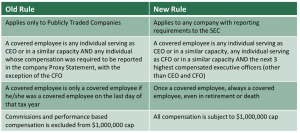
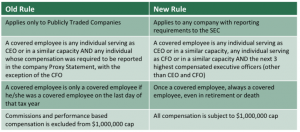
This alert serves as part two of a two-part alert regarding changes to section 162(m) of the IRS tax code. Part two focuses on recommended steps to maintain and maximize grandfathered compensation, particularly in Non-Qualified Deferred Compensation (NQDC) Plans. If you have not read part one of this notice, please visit the Mullin Barens Sanford Financial website here to familiarize yourself with the law changes. The chart below provides a brief comparison of section 162(m) before and after the rule change.

Recently, the IRS issued Notice 2018-68, providing guidance under Section 162(m) of the Internal Revenue Code, as amended by the 2017 Tax Cuts and Jobs Act (the “2017 Act”). Section 162(m) disallows the deduction of compensation paid by public companies to covered employees to the extent such amounts exceed $1 million per year. The 2017 Act changed the definition of covered employees, expanded the entities subject to Section 162(m), and eliminated the exception for commission and performance-based compensation. Application of the new rules commences in 2018, except that compensation paid pursuant to a binding written contract that was in effect on November 2, 2017, is grandfathered as long as such contract is not material modified after that date.

Grandfathering of Compensation

IRS guidance has significantly tightened rules for deducting executive compensation, but it has also provided an avenue for some compensation to be grandfathered to maintain deductibility. The provision is based on the premise of allowing compensation which has already been promised to an executive with a binding contract to be grandfathered. However, if the contract permits either party to modify the level of compensation it will not be grandfathered. Further still, the ability to reduce compensation or cancel the contract will minimize grandfathered compensation. Generally, accrued balances in NQDC plans will be grandfathered, even if compensation will be paid after the November 2, 2017 deadline. However in many cases, the company has authority to unilaterally terminate a NQDC plan or change the investment crediting options which may prevent future interest on existing balances to be grandfathered.

Determining 162(m) Deductibility in an NQDC Plan

In order to determine if plan balances in an NQDC plan are deductible, plan sponsors must assess whether balances would have been deductible under old rules and then bifurcate balances which are deductible from those which are not. This must be done on an employee by employee basis, considering several factors as outlined below.

Covered Employees

Recall that only “covered employees” are subject to the $1M compensation deductibility limit under section 162(m). The account balance of any participant who was not a covered employee before November 2, 2017 can be grandfathered as of that date. Of particular importance is the CFO of the plan sponsor. Prior rules did not consider the CFO a covered employee, but the new rules do. As such, the CFO’s balance as of November 2, 2017 should be grandfathered and so deductible at the time of distribution, but any additional accruals thereafter will be subject to the limit.

Performance Based Compensation

Perhaps the most impactful change to 162(m) is the removal of the performance-based pay exemption. However, even if an employee was a covered employee while contributing to the plan, if the contribution came from performance-based pay, the employee’s account balance as of November 2, 2017 may be deductible at distribution.

Time of Distribution

NQDC plans have historically been an excellent strategy for allowing more compensation to be deductible under 162(m) by deferring applicable compensation into retirement-after an employee is no longer a “covered employee.” However, under the new rules covered employees are still covered after termination. Account balances as of November 2, 2017 which are distributed post termination may still be grandfathered, but future accruals will be subject to the new rules in the year of distribution. However, the total amount payable to a retired employee is likely to be significantly less during retirement such that nonqualified deferrals are still an important way to minimize the application of 162(m).

Ability to Terminate the Plan

If the plan sponsor does not have the unilateral ability to terminate the plan, the NQDC plan document will likely act as a binding written contract 162(m) purposes. This binding contract allows promised compensation to be deducted, including balances contributed before November 2, 2017 and the minimum guaranteed crediting rate outlined in the plan.

If the plan sponsor maintains the ability to terminate the plan and/or change the investment crediting options, it effectively removes the ability to grandfather future interest earnings in the Plan. Balances as of November 2, 2017 for covered employees can still be grandfathered as long as the employer does not have the unilateral right to reduce account balances, but additional interest or investment gains will likely not be grandfathered.

Conclusion

Recent IRS guidance has clarified how they interpret and will administer the redefining of Section 162(m). While guidance has severely limited ability to grandfather compensation, NQDC plans allow several avenues for deductibility of current plan balances. In order to take advantage of these avenues, plan sponsors must consult with outside counsel to review the NQDC accounts of their covered employees to maximize deductibility at a future distribution.

Another consequence of this IRS guidance is the newfound prominence of NQDC plans in managing tax consequences of future compensation. While new rules have effectively removed exemptions from the $1M limit, NQDC plans can still allow plan sponsors to spread compensation over several years-minimizing the tax burden in any one year. Consult with your contact at Mullin Barens Sanford Financial to learn more about how an NQDC plan can assist in tax planning surrounding Section 162(m).

About Mullin Barens Sanford Financial

Through a powerful combination of independence and experience, Mullin Barens Sanford Financial and Insurance Services (MBS Financial) is a leading consulting firm that assists companies with 409A and other executive benefit needs.

Disclaimer: The materials are designed to convey accurate and authoritative information concerning the subject matter covered. However, they are provided with the understanding that Mullin Barens Sanford does not engage in the practice of law, or give tax, legal or accounting advice. For advice in these areas please consult your appropriate advisors.

© 2025 Mullin Barens Sanford Financial and Insurance Services, LLC. All Rights Reserved.
2242 Purdue Avenue, Los Angeles, California 90064 |Website: www.mbsfin.com
Securities offered through M Holdings Securities, Inc., a Registered Broker/Dealer, Member FINRA/SIPC. #4444620

IRS Guidance: Application Of Code Section 162(m) With Grandfathering Rules (Part 1)

Recently, the IRS issued Notice 2018-68, providing guidance under Section 162(m) of the Internal Revenue Code, as amended by the 2017 Tax Cuts and Jobs Act (the “2017 Act”). Section 162(m) disallows the deduction of compensation paid by public companies to covered employees to the extent such amounts exceed $1 million per year. The 2017 Act changed the definition of covered employees, expanded the entities subject to Section 162(m), and eliminated the exception for commission and performance based compensation. Application of the new rules commences in 2018, except that compensation paid pursuant to a binding written contract that was in effect on November 2, 2017, is grandfathered as long as such contract is not material modified after that date.

Changes to a Covered Employee

A covered employee is defined as including any employee who is (or is acting as) the principal executive officer (PEO) or principal financial officer (PFO) of the publicly held corporation at any time during the tax year. In addition, a covered employee includes any employee among the three highest-compensated officers for the tax year (other than the PEO or PFO) as computed under the Securities Exchange Act of 1934, even if his or her compensation is not required to be reported. The Notice specifically provides that a covered employee does not need to have qualified as such at the end of the tax year as long as he or she met the definition at any time during the tax year. The Notice also specifies that once an employee is considered a covered employee in any year beginning after December 31, 2017 he or she will always be a covered employee, regardless of employment status.

Binding Contract

The grandfather rule will only continue to exempt compensation if it is paid pursuant to a binding written contract that was in effect on November 2, 2017. Amounts will be grandfathered only if the employer is obligated under applicable law to pay such amounts if all applicable performance criteria and vesting conditions are met. If an award is subject to negative discretion, because the employer has the right to adjust the payment downward, the Notice provides that it will not be considered to be a binding right to the extent of such negative discretion. Thus, for example, if a contract provides that an award which is dictated by specified performance criteria is subject to a 20% downward adjustment at the discretion of a company’s compensation committee, only 80% of the amount produced by the performance formula will be grandfathered. However, failure to exercise negative discretion will not be considered a material modification so that if the employer pays the full 100% produced by the award formula, 80% will still be grandfathered and the other 20% will be counted against the compensation limitation. Also, if the employer may cancel or terminate a binding written contract without the employee’s consent, that contract is treated as renewed as of the date that any such cancellation or termination, if made, would be effective.

Material Modification

The Notice clarifies that a “material modification” will be deemed to occur only if a contract is amended to increase the amount of compensation paid to the employee. If a modification accelerates the timing of payment, it will be considered material unless the payment is discounted to reasonably reflect the time value of money. If the award is modified to defer payment, it will not be considered material unless the amount payable is increased by more than a reasonable rate of interest or crediting based on a predetermined actual investment. The adoption of a supplemental contract or agreement that provides increased compensation may also be considered a material modification of an existing right of facts and circumstance suggest that it is based on the same elements or conditions as the original award such that it constitutes a de facto increase in the original award.

Conclusion

Though the Tax Cuts and Jobs Act was passed at the end of 2017 and included new 162(m) provisions at that time, guidance from the IRS on how it will be administered is only now coming into focus. Several factors, including the position of the employee, whether compensation is performance based, and when the distribution occurs will determine whether or not compensation is deductible.
In the coming weeks, stay tuned for part two of this notice from Mullin Barens Sanford Financial. Part two will outline further the steps your company can take to understand potential grandfathering of executive deferred compensation.

About Mullin Barens Sanford Financial

Through a powerful combination of independence and experience, Mullin Barens Sanford Financial and Insurance Services (MBS Financial) is a leading consulting firm that assists companies with 409A and other executive benefit needs.

Disclaimer: The materials are designed to convey accurate and authoritative information concerning the subject matter covered. However, they are provided with the understanding that Mullin Barens Sanford does not engage in the practice of law, or give tax, legal or accounting advice. For advice in these areas please consult your appropriate advisors.

© 2025 Mullin Barens Sanford Financial and Insurance Services, LLC. All Rights Reserved.
2242 Purdue Avenue, Los Angeles, California 90064 |Website: www.mbsfin.com
Securities offered through M Holdings Securities, Inc., a Registered Broker/Dealer, Member FINRA/SIPC. #4444620

Bankruptcy And Non-Qualified Deferred Compensation Plans

The Internal Revenue Code requires that a Non-Qualified Deferred Compensation Plan (“NQDCP”) must be treated as an unsecured promise to pay future benefits such that participants can defer current income recognition.

Therefore, a NQDCP participant will have the status of a general unsecured creditor of the plan sponsor in bankruptcy with respect to his/her NQDCP benefits. Even amounts that are set aside in a Rabbi Trust to pay NQDCP liabilities are treated as general assets of the plan sponsor in bankruptcy and thus remain subject to the claims of the plan sponsor’s general creditors.

Bankruptcy Process Overview 

A bankruptcy is a public, judicial process during which a debtor corporation (or individual) and its creditors will resolve outstanding debts with certain protections afforded by the U.S. Bankruptcy Code. The fundamental goal of the U.S. Bankruptcy Code is to give debtors a financial “fresh start” from burdensome debts. The U.S. Supreme Court made this point about the purpose of the bankruptcy law in a 1934 decision Local Loan vs. Hunt:

“It gives to the honest but unfortunate debtor…a new opportunity in life and a clear field for future effort, unhampered by the pressure and discouragement of preexisting debt.”

Businesses may file for bankruptcy under Chapter 7 (Liquidation) or Chapter 11 (Reorganization). In a Chapter 7 filing, a court-appointed trustee takes over the assets of the debtor’s estate, reduces them to cash, and makes distributions to creditors (which may or may not include NQDCP participants depending on the level of assets held by the debtor). In a Chapter 11 filing, the debtor usually files a plan of reorganization whereupon NQDCP claims are typically resolved after the Petition Date, as part of a “second day order” (which typically occurs after the second day of the bankruptcy). An appointed unsecured creditors committee will generally have the most influence in determining the ultimate outcome of the pre-petition NQDCP accrued benefits.

Non-Qualified Deferred Compensation Impact

Upon the filing date of a bankruptcy petition (“Petition Date”), NQDCP payments are subject to an “automatic stay” in which payments are suspended for allparticipants. NQDCP participants who have accrued benefits before the bankruptcy filing (otherwise known as “pre-petition obligations”) are permitted to file claims to the bankruptcy court to the extent that their claims are not accurately scheduled by the debtor in order to preserve their rights under a bankruptcy.

One essential factor for Rabbi Trust structure is demonstrated in The Seventh Circuit case of Bank of America, Inc. vs. Moglia. This case clarified that “general creditors” means only the unsecured creditors. As such, the court held that the Rabbi Trust assets were subject only to the claims of the unsecured creditors. If the trust had said that the trust assets were subject to the claims of all creditors of the company, then the secured creditors would have the valid claim. If Rabbi Trust assets are subject to the claims of the secured creditors, the NQDCP participants would have much less of a chance of recovering their deferred compensation benefits. From the point of view of protecting the interests of plan participants, this case shows the importance of preparing the Rabbi Trust language such that the assets are subject only to the unsecured general creditors of the company.

Several factors can determine whether, and to what extent, a participant will receive his/her NQDCP benefits, including but not limited to:

  • Chapter 7 vs. Chapter 11 filing
  • Current vs. former employees
  • Breadth of employee participation in the plan
  • Change in ownership or control of the plan sponsor
  • Change in senior leadership of the plan sponsor

Generally speaking, if a company remains an ongoing concern post-bankruptcy, employee compensation and goodwill will be more likely considered to be critical factors post-bankruptcy and thus more likely to protect NQDCP benefits.

Note that any NQDCP accruals that are earned after the Petition Date are considered “post-petition obligations” and are not subject to the plan sponsor’s general unsecured creditors. They are generally required to be paid if considered “administrative expenses” under bankruptcy law.

Please see Appendix for a summary of bankruptcy cases and their treatment of NQDCP plans therein, over the last two decades. However, please note that treatment under past bankruptcies does not guarantee similar treatment for future bankruptcies.

Appendix

Arch Coal

Arch Coal Inc., one of the largest coal producers in the United States, filed for Chapter 11 bankruptcy in January 2016. In subsequent communications to its employees, the company indicated that it expects “little or no recovery of funds contributed to the Deferred Compensation Plan prior to the Chapter 11 filing.”

Armstrong World Industries

Armstrong World Industries, Inc. filed a voluntary petition for relief under Chapter 11 in order to use the bankruptcy reorganization process to achieve a resolution of its asbestos-related liability. In October 2006, the company emerged from Chapter 11 and in connection therewith, the Deferred Compensation Plan participants recovered their entire accrued benefits.

Bank of America/Outboard Marine

Outboard Marine Corp. had filed for Chapter 7 bankruptcy. It had contributed $14 million to a Rabbi Trust to fund its NQDC plan. The bankruptcy trustee claimed this amount was available to the unsecured creditors of Outboard Marine. Bank of America, the agent for the secured creditors, said that the secured creditors had a claim to this money because the security agreement that Bank of America relied on covered “general intangibles” and described Rabbi Trust assets. The Rabbi Trust, however, said that the trust assets belonged only to “general creditors” of the company. The Seventh Circuit, in the case of Bank of America, Inc. vs. Moglia, explained that “general creditors” means only the unsecured creditors. If the trust had said that the trust assets were subject to the claims of all creditors of the company, then the secured creditors would have a valid claim. As such, the court held that the Rabbi Trust assets were subject only to the claims of the unsecured creditors.

Caesars Entertainment

Caesars Entertainment, the largest casino chain in the U.S., filed for Chapter 11 bankruptcy in January 2015 upon which time payments from its five deferred compensation plans were suspended. As of May 2015, payments from two of the plans were resumed because the US Attorney’s office was investigating whether the plan liabilities were illegally transferred to the bankrupt entity prior to the bankruptcy filing. In October 2016, Caesars Entertainment agreed to fully assume responsibility for all five deferred compensation plans totaling $90 million as part of a settlement with the casino company’s bankrupt operating unit. The settlement, approved by a bankruptcy judge, resolved a lingering dispute between Caesars Entertainment and its subsidiary Caesars Entertainment Operating Co., now in Chapter 11, over which entity is responsible for making continued payments to employees under the plans.

CIT Group

CIT Group declared Chapter 11 bankruptcy on November 1, 2009, and with the consent of its bondholders, proposed to quickly emerge from bankruptcy court proceedings. On December 10, 2009, CIT satisfied all of the conditions required to consummate the prepackaged Plan of Reorganization (the “Plan”). The distribution of CIT’s new debt and equity securities took place in accordance with the company’s confirmed Plan and the new common stock commenced trading on the New York Stock Exchange (NYSE) under the symbol “CIT.” All previously issued and outstanding common stock and preferred stock was cancelled. As CIT was to remain an ongoing entity, executive benefits including deferred compensation plans and its liabilities survived intact.

Eastman Kodak

Eastman Kodak filed for bankruptcy in January 2012. Kodak’s Plan of Reorganization (Aug. 20, 2013) stipulated that the Executive Deferred Compensation Plan (EDCP) participants, with total balances equaling $15 million, would receive only 4%-5% of their deferred salaries and incentive awards. Delivery was not to be in cash but in common shares of the new Kodak to be issued upon the company’s emergence from Chapter 11. Taxation upon grant to the creditors (including participants in the Kodak EDCP), was as ordinary income based on the value at grant. No deductions would be permitted for amounts lost. Recovery of the $15 million in salary and bonuses owed to former Kodak managers was to be treated under the plan of reorganization in the same way as the other $2.8 billion in unsecured debt, including unfunded pensions, accounts payable, customer rebates, royalties, shippers/warehouses, and litigation. Only the former EDCP participants forfeited a large portion of their deferred compensation.

Enron

CEO Kenneth Lay, along with several other executives, cashed out of their deferred compensation plans (with assets held in a Rabbi Trust) just prior to official bankruptcy. A U.S. bankruptcy judge authorized Enron to pursue $53 million in accelerated deferred compensation paid by the company shortly before its bankruptcy filing. Enron sent letters to the recipients of such accelerated deferred compensation, demanding the return of between 40% – 90% of the money. Those who remained with the company were asked to repay less because they were perceived to have provided a post-bankruptcy benefit to Enron’s creditors. As of May 2006, settlements were reached with 104 individuals for a net benefit to Enron’s estate of more than $36 million.

Section 409A of the Internal Revenue Code was enacted, in part, in response to the practice of Enron executives accelerating the payments under their deferred compensation plans in order to access the money before the company went bankrupt, and also in part, in response to a history of perceived tax-timing abuse due to limited enforcement of the constructive receipt tax doctrine.

General Motors (GM)

GM filed for Chapter 11 reorganization in the New York federal bankruptcy court on June 1, 2009. Under the bankruptcy, participants in GM’s deferred compensation plan received a two-thirds (2/3) “haircut” of any benefits in excess of an annual distribution of $100,000.

Lyondell/Arco Chemical

The bankruptcy occurred in 2010. Lyondell had an active deferred compensation plan while the Arco Chemical plan was terminated with participants in payout status. In both cases, a Rabbi Trust was in place with less than 100% funding. Participants in both plans received a pro-rata share of the funding, i.e. if the trust was 80% funded, they received 80% of what they were owed, even if other general creditors received a lesser amount.

Nortel Networks

On January 14, 2009, Nortel filed for bankruptcy protection from its creditors in the United States, Canada, and the United Kingdom, in order to restructure its debt and financial obligations. In June 2009, the company announced it would cease operations and sell off all of its business units. The period of bankruptcy protection was extended to February 2, 2013. As part of the bankruptcy proceedings in the United States, Nortel reportedly reached a settlement with former executives who were entitled to receive $31 million in the aggregate for a recovery of 97% of the funds that were in their deferred compensation accounts on the day Nortel filed for bankruptcy.

Pacific Gas & Electric (PG&E)

In April 2001, PG&E filed a voluntary petition for relief under Chapter 11 of the U.S. Bankruptcy Code. As the company remained a going concern post-bankruptcy, the deferred compensation plan’s funding remained intact post-bankruptcy, and annuities that were purchased to replace a significant portion of the unfunded plan benefits for certain officers were not liquidated.

Pilgrim’s Pride

Pilgrim’s Pride Corp., a large poultry producer, lost $1 billion in 2008 as higher grain prices, an oversaturated chicken market and looming debts, forced the Texas-based company into bankruptcy protection. However, since the company was to remain a going concern post-bankruptcy, the deferred compensation plans were assumed and executives survived with 100% of their benefits intact.

Washington Mutual (WAMU)

The former parent of the thrift bank that went into bankruptcy, Washington Mutual Bank (WAMU) allowed its senior executives to pull millions out of its deferred compensation plan trust before it filed for bankruptcy.

However, WAMU claimed $69 million in deferred compensation plan assets of its acquired subsidiary, Home Savings of America (HSA). Ultimately, WAMU prevailed and the deferred compensation assets of HSA remained with the estate of WAMU for distribution to its creditors.

About Mullin Barens Sanford Financial

Through a powerful combination of independence and experience, Mullin Barens Sanford Financial and Insurance Services (MBS Financial) is a leading consulting firm that assists companies with 409A and other executive benefit needs.

Disclaimer: The materials are designed to convey accurate and authoritative information concerning the subject matter covered. However, they are provided with the understanding that Mullin Barens Sanford does not engage in the practice of law, or give tax, legal or accounting advice. For advice in these areas please consult your appropriate advisors.

© 2025 Mullin Barens Sanford Financial and Insurance Services, LLC. All Rights Reserved.
2242 Purdue Avenue, Los Angeles, California 90064 | Website: www.mbsfin.com
Securities offered through M Holdings Securities, Inc., a Registered Broker/Dealer, Member FINRA/SIPC. #4444620

Weighing The Options For Informally Funding Non-Qualified Benefits

Disclaimer: The materials are designed to convey accurate and authoritative information concerning the subject matter covered. However, they are provided with the understanding that Mullin Barens Sanford does not engage in the practice of law, or give tax, legal or accounting advice. For advice in these areas please consult your appropriate advisors.

© 2025 Mullin Barens Sanford Financial and Insurance Services, LLC. All Rights Reserved.
2242 Purdue Avenue, Los Angeles, California 90064 | Website: www.mbsfin.com
Securities offered through M Holdings Securities, Inc., a Registered Broker/Dealer, Member FINRA/SIPC. #4444620

« Previous Page
Next Page »

Recent Posts

  • 2026 MBS NQDC Recordkeeper Survey
  • IRS Announcement: 2026 Qualified Retirement Plan Limits
  • 2024 NQDCP Recordkeeper Survey
  • Mind The (Income Protection) Gap
  • MBS Financial Certified As Women-Owned Business

Recent Comments

No comments to show.
Mullin Barens Sanford Financial & Insurance Services

Disclosures | Privacy Policy (PDF, opens in a new tab)
© 2026 Mullin Barens Sanford Financial & Insurance Services, LLC

  • Our Services
    • NQDCP
    • COLI
    • BOLI
    • ICOLI
    • Executive Disability
  • About MBS Financial
    • About Us
    • Our Team
    • The Mullin Legacy
    • M Financial Group
  • Resources
    • Surveys
    • Insights
    • News
    • Contact Us
M Financial Group Member Firm

We value your privacy

We use cookies to keep this site reliable, understand how it’s used, and — with your permission — to personalize content. You can accept all, reject non-essential, or choose which categories to allow.

Cookie Preferences