
Mullin Barens Sanford Financial & Insurance Services
    • NQDCP
    • COLI
    • BOLI
    • ICOLI
    • Executive Disability
    • About Us
    • Our Team
    • The Mullin Legacy
    • M Financial Group
    • Surveys
    • Insights
    • News
  • Contact Us
    • NQDCP
    • COLI
    • BOLI
    • ICOLI
    • Executive Disability
    • About Us
    • Our Team
    • The Mullin Legacy
    • M Financial Group
    • Surveys
    • Insights
    • News
  • Contact Us

How To Minimize Your Risk-Based Capital Reserving

Minimizing your risk-based capital reserving maximizes the amount of capital invested in your portfolio.

A common way in which insurance carriers reduce their risk-based capital reserving is by wrapping a portion of their on-balance sheet investments in institutional life insurance.
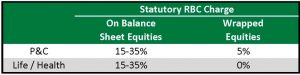

Is this really a commonly used strategy? Yes. For example, Met Life has +$2.7B of their investments wrapped, Mass Mutual wrapped +$2.2B of their portfolio, Nationwide, John Hancock, Liberty Mutual, and Midland National have wrapped more than +$1B of their investment portfolios.

One of many reasons investment committees move to wrap their equities in institutional life insurance is because doing so carries lower capital costs when compared to the same unwrapped equity investment. The result is that the investment committee can free up some reserve capital to deploy back into the carrier’s investment portfolio.

The NAIC recommends that investments held within institutional life insurance have a risk-based capital charge of 0% for life & health carriers and 5% for P&C carriers – regardless of the type of investment that is wrapped. Very importantly, ratings agencies also closely align with this risk-based capital charge recommendation.

If you would like learn more about this concept, or what your peers are doing in this area, please reach out or schedule a call via this link.

Erik Speed
Associate Principal
(818) 292-7206
Erik.Speed@mbsfin.com

About Mullin Barens Sanford Financial

Through a powerful combination of independence and experience, Mullin Barens Sanford Financial and Insurance Services (MBS Financial) is a leading consulting firm that assists companies with 409A and other executive benefit needs.

Disclaimer: The materials are designed to convey accurate and authoritative information concerning the subject matter covered. However, they are provided with the understanding that Mullin Barens Sanford does not engage in the practice of law, or give tax, legal or accounting advice. For advice in these areas please consult your appropriate advisors.

© 2025 Mullin Barens Sanford Financial and Insurance Services, LLC. All Rights Reserved.
1421 Emerson Avenue, Oxnard, California 93033 | Main (650) 740-7773 | Website: www.mbsfin.com
Securities offered through M Holdings Securities, Inc., a Registered Broker/Dealer, Member FINRA/SIPC. #4444620
IRC 162(m) | Executive Pay Limits Included In Covid Stimulus Package

The American Rescue Plan Act of 2021 (commonly referred to as the $1.9 trillion coronavirus aid package) includes a provision that will double the number of the highest-paid executives whose compensation in excess of $1 million cannot be deducted by their employers.

Public companies are currently prohibited from deducting more than $1 million per year in compensation for five employees – the chief executive officer, the chief financial officer and the three highest-paid executives at the company.  The new legislation, signed into law yesterday, Thursday, March 11, adds five more highly paid officials to the list, starting in 2027.

Prior legislative changes to Code Section 162(m) included in the 2017 Tax Cuts and Jobs Act were:

  • Increasing the number of covered executives whose compensation could not be written off from four to five (adding the CFO back to the list of five),
  • removing performance-based bonus exemptions, and
  • Establishing that once an executive is covered under the law, they are always a covered employee, forcing retirement distributions to also be subject to the deductibility cap.

The new 2021 law treats employees from six to 10 differently, in that they are only covered for the applicable year when earnings exceed $1 million, rather than cumulatively.

If you would like to discuss this legislation and its impact on your nonqualified executive plans, please reach out to your Mullin Barens Sanford Financial consultant or schedule a call via this link.

About Mullin Barens Sanford Financial

Through a powerful combination of independence and experience, Mullin Barens Sanford Financial and Insurance Services (MBS Financial) is a leading consulting firm that assists companies with 409A and other executive benefit needs.

Disclaimer: The materials are designed to convey accurate and authoritative information concerning the subject matter covered. However, they are provided with the understanding that Mullin Barens Sanford does not engage in the practice of law, or give tax, legal or accounting advice. For advice in these areas please consult your appropriate advisors.

© 2025 Mullin Barens Sanford Financial and Insurance Services, LLC. All Rights Reserved.
2242 Purdue Avenue, Los Angeles, California 90064 | Website: www.mbsfin.com
Securities offered through M Holdings Securities, Inc., a Registered Broker/Dealer, Member FINRA/SIPC. #4444620

Legislative Update

COVID-19 Relief Bill Corrects Statutory Interest Rates for New Life Insurance Policies

Consolidated Appropriations Act, 2021 included an update to Internal Revenue Code Section 7702 (definition of life insurance for tax purposes) interest rates to reflect current economic conditions. Unfortunately, recent economic reality, exacerbated by the COVID pandemic, combined with an outdated section of the tax code, threatened product availability essential to consumers’ financial security. In response, the industry worked with Congress throughout 2020 to update section 7702 of the tax code in order to ensure a robust marketplace of permanent life insurance products would continue to be available for individuals, families, and businesses.

To qualify as life insurance contracts for tax purposes, permanent life insurance policies must meet several requirements under IRC Section 7702. These requirements include the use of two interest rate assumptions for determining premium amounts. The interest rate assumptions were set at 4% and 6% when Section 7702 was enacted in 1984.

In that year, the average long-term Treasury rate was near 12%. At the start of 2021, 10-year U.S. Treasury note rates are near 1%. The legislative change corrected the hard-coded interest rate assumptions so that new policies will move to a floating rate the reflects current market conditions.

The provision of lower interest rates means that for a given death benefit, the maximum premium that can be paid will be greater, potentially lowering insurance charges, and providing for greater cash value accumulation and lowering the risk of policy lapse.

Life insurance companies are now in the process of repricing all life insurance products, and as we learn more about the impact of these changes, we will update you with important developments.

If you would like to discuss this recent legislative change and how it may impact new life insurance offerings, please reach out to your Mullin Barens Sanford Financial consultant or schedule a call via this link.

About Mullin Barens Sanford Financial

Through a powerful combination of independence and experience, Mullin Barens Sanford Financial and Insurance Services (MBS Financial) is a leading consulting firm that assists companies with 409A and other executive benefit needs.

Disclaimer: The materials are designed to convey accurate and authoritative information concerning the subject matter covered. However, they are provided with the understanding that Mullin Barens Sanford does not engage in the practice of law, or give tax, legal or accounting advice. For advice in these areas please consult your appropriate advisors.

© 2025 Mullin Barens Sanford Financial and Insurance Services, LLC. All Rights Reserved.
2242 Purdue Avenue, Los Angeles, California 90064 | Website: www.mbsfin.com
Securities offered through M Holdings Securities, Inc., a Registered Broker/Dealer, Member FINRA/SIPC. #4444620

BOLI Market Update – 3rd Quarter 2020

Continued Low Interest Rate Environment – Regulatory Help Could Be on the Way

Entering the twelfth year of historically low interest rates, and with the Federal Reserve indicating rates will stay low for at least the next two years, banks are having a harder time than ever finding yield.  With net interest margins falling to a record low, BOLI has become an even more popular alternative investment for banks searching for returns.  Particularly in 2020, with a pandemic taking its toll on the economy and the 10-year treasury hovering just over 100 basis points in early 2021, banks are seeking yield and have found it in BOLI.  In the third quarter of 2020 alone, there were approximately 97 purchases of $1,000,000 or more of BOLI totaling over $1 billion in premium.  Contributing to the growth of the marketplace, 9 of those purchases were made by first time BOLI buyers.

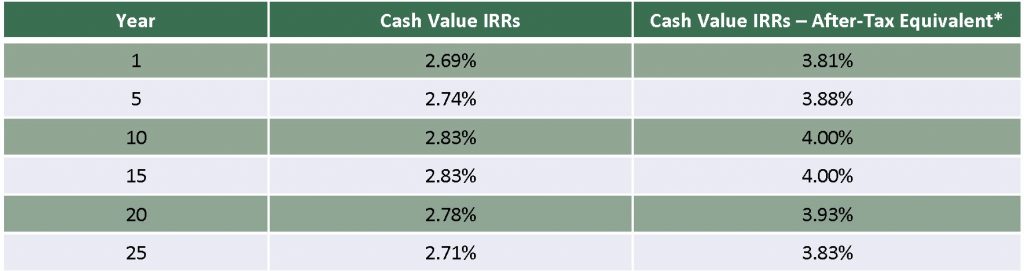
Attractive returns combined with tax free growth offered in BOLI policies are behind the large volume of cases.  The table below illustrates expected returns from a BOLI policy purchased on a 45-year-old male.

*Assumes 29% Corporate Tax rate

Regulatory Relief

The very last session of congress in 2020 generated a somewhat surprising but beneficial result for the life insurance consumer.  Life insurance products are governed by IRC Section 7702, which imposes several requirements on every policy sold.  In many cases, 7702 forced banks to buy a specific form of life insurance called a modified endowment contract (MEC) to generate the rate of return they were seeking.  MECs still provide banks with favorable tax treatment and returns but limit the liquidity that could be generated from the policies – a hurdle too high to overcome for some banks.

However, changes made by the Consolidated Appropriations Act will allow most life insurance products to be more efficient and generate higher rates of return relative to past products.  The new 7702 could have profound impacts on how banks buy life insurance by allowing them to buy policies with the higher rates of return they seek without the liquidity issues they ran into in the past.  Beneficial impacts brought on by changes to Section 7702 combined with higher corporate tax rates signaled by the new administration will make BOLI a premier asset for banks in 2021.

If you have questions about BOLI or would like to explore an investment, please contact your Mullin Barens Sanford consultant.

About Mullin Barens Sanford Financial

Through a powerful combination of independence and experience, Mullin Barens Sanford Financial and Insurance Services (MBS Financial) is a leading consulting firm that assists companies with 409A and other executive benefit needs.

Disclaimer: The materials are designed to convey accurate and authoritative information concerning the subject matter covered. However, they are provided with the understanding that Mullin Barens Sanford does not engage in the practice of law, or give tax, legal or accounting advice. For advice in these areas please consult your appropriate advisors.

© 2025 Mullin Barens Sanford Financial and Insurance Services, LLC. All Rights Reserved.
1421 Emerson Avenue, Oxnard, California 93033 | Website: www.mbsfin.com
Securities offered through M Holdings Securities, Inc., a Registered Broker/Dealer, Member FINRA/SIPC. #4444620

NDCP | Best Ways To Pay For College

Are Nonqualified Deferred Compensation Plans the Best Way to Pay for College?

In the Winter 2020 edition of Defined Contribution Insights (available here) Plan Sponsor Council of America (PSCA) published the first of a two-part article comparing saving for educational expenses via a tax-qualified 529 Plan and a nonqualified deferred compensation plan (DCP) or 409A plan.

MBS Principal John Sanford, co-author of the article, reviews 409A plans and how they may be used to pay for college expenses. Highlights include:

  • Planning and saving for college expenses as early as possible is key to meeting future needs.
  • A 409A DCP is a pre-tax contribution with tax-deferred growth and ordinary income taxes being paid upon distribution, so there is more focus on future income tax rates.
  • The 409A DCP has no restriction on contributions and total flexibility over how distributions are used.
  • If needs change, the distribution can be postponed and/or redirected into another account. This flexibility can facilitate converting unused or unneeded college education balances into retirement savings.
  • Additional benefits include aligning participant incentives with meeting specific goals and the ability for participants to arrange distributions in order to reduce or avoid paying state income tax.

Plan Sponsors may want to note the advantage of funding education expenses in their DCP enrollment material.

If you would like to discuss the advantages of using a deferred compensation plan to save for educational and/or other future expenses, please reach out to your Mullin Barens Sanford Financial consultant or schedule a call via this link.

About Mullin Barens Sanford Financial

Through a powerful combination of independence and experience, Mullin Barens Sanford Financial and Insurance Services (MBS Financial) is a leading consulting firm that assists companies with 409A and other executive benefit needs.

Disclaimer: This material is intended for informational purposes only and should not be construed as legal or tax advice and is not intended to replace the advice of a qualified attorney, tax advisor or plan provider. Investments in securities involve risks, including the possible loss of principal. When redeemed, shares may be worth more or less than their original value.

© 2025 Mullin Barens Sanford Financial and Insurance Services, LLC. All Rights Reserved.
2242 Purdue Avenue, Los Angeles, California 90064 | Website: www.mbsfin.com
Securities offered through M Holdings Securities, Inc., a Registered Broker/Dealer, Member FINRA/SIPC. #4444620

Supplemental Employee Term Life Insurance

Today’s economic environment and health concerns have many thinking differently about their financial plans.  Life insurance has taken on a renewed prominence at the forefront of American’s lives, while providers have been innovating more efficient ways to offer coverage.

Competitive Online Term Life Insurance Marketplace

In accordance with all aspects of everyday life moving more online, life insurers have developed online: applications, underwriting, issuance, and payment processing – all steps which used to be done in person.  This result has led to several highly rated life insurers offering large death benefits at competitive rates with minimal underwriting requirements.

Voluntary Benefit Offering

Online platforms and decreased underwriting requirements have made offering flexible, voluntary benefits easier and more effective than ever.  By giving your employees and their immediate family the ability to apply and receive coverage all from the comfort of their own home, you can help solve one of the biggest concerns individuals and families are facing today.

If you are interested in offering additional term life insurance to your employees, Mullin Barens Sanford Financial will work with you to develop communication materials and guide your employees through the process.  Schedule a call here to learn more.

About Mullin Barens Sanford Financial

Through a powerful combination of independence and experience, Mullin Barens Sanford Financial and Insurance Services (MBS Financial) is a leading consulting firm that assists companies with 409A and other executive benefit needs.

Disclaimer: The materials are designed to convey accurate and authoritative information concerning the subject matter covered. However, they are provided with the understanding that Mullin Barens Sanford does not engage in the practice of law, or give tax, legal or accounting advice. For advice in these areas please consult your appropriate advisors.

© 2025 Mullin Barens Sanford Financial and Insurance Services, LLC. All Rights Reserved.
2242 Purdue Avenue, Los Angeles, California 90064 | Website: www.mbsfin.com
Securities offered through M Holdings Securities, Inc., a Registered Broker/Dealer, Member FINRA/SIPC. #4444620

Risks When Bundling Qualified And Nonqualified Plan Recordkeeping

A $55 million settlement after 13 years in litigation in the case of Tussey vs. ABB, illustrates the dangers of bundling qualified and non-qualified plans with the same recordkeeper.  In an effort to maximize cost efficiency, ABB hired the same recordkeeper to administer both its qualified and non-qualified retirement plans. The recordkeeper, eager to maintain both plans cost effectively, applied revenue from the qualified plan to non-qualified plan fees.  The recordkeeper also went a step further by recommending its own mutual funds in the qualified plan in favor of lower cost, equally as effective funds – directly costing qualified plan participants money. The result was additional revenue for the plan recordkeeper and lower fees for the plan sponsor, but a breach in fiduciary responsibility and a form of “self-dealing” prohibited by ERISA, which led to the lawsuit.

Tussey vs. ABB is a reminder of the need to seek out the best vendor for qualified plans and non-qualified plans separately.  In addition to finding specialized service, bifurcating the plans mitigates fiduciary risk.

To learn more about the Case of Tussey vs. ABB, contact your Mullin Barens Sanford consultant or schedule a call via the link.

About Mullin Barens Sanford Financial

Through a powerful combination of independence and experience, Mullin Barens Sanford Financial and Insurance Services (MBS Financial) is a leading consulting firm that assists companies with 409A and other executive benefit needs.

Disclaimer: The materials are designed to convey accurate and authoritative information concerning the subject matter covered. However, they are provided with the understanding that Mullin Barens Sanford does not engage in the practice of law, or give tax, legal or accounting advice. For advice in these areas please consult your appropriate advisors.

© 2025 Mullin Barens Sanford Financial and Insurance Services, LLC. All Rights Reserved.
2242 Purdue Avenue, Los Angeles, California 90064 | Website: www.mbsfin.com
Securities offered through M Holdings Securities, Inc., a Registered Broker/Dealer, Member FINRA/SIPC. #4444620

Use Deferred Compensation Plans In Place Of Salary Reductions

The COVID-19 pandemic has had profound impacts on the day to day business of most American companies.  Shelter in place orders and social distancing recommendations, while necessary, also mean that customers are less frequent, and revenues are harder to come by.  Cash flow needs have become paramount as a result, which has led some companies to take hard but necessary steps to retain that cash flow.  In some cases, that has meant reducing pay to a majority of employees.

Deferred compensation arrangements can provide the same immediate cash flow relief as compensation reductions, but without the permanent effects.  By shifting from a reduction in pay to a deferral of pay, companies retain the cash that would have otherwise been paid.  That cash can then be deployed where the immediate need is required, but importantly, will be paid to employees when a more normal business environment returns.

For companies which have been forced to reduce compensation at all levels of the organization, non-ERISA deferred compensation plans can be particularly practical.  These underutilized plans can improve cash flow immensely even with small deferral contributions.  However with a promise to pay in a short time frame, employers can maintain goodwill with employees better than with a salary reduction.

If you would like to learn more about how deferred compensation plans can be utilized to improve cash flow, please reach out to your Mullin Barens Sanford  consultant or schedule a call via the link.

About Mullin Barens Sanford Financial

Through a powerful combination of independence and experience, Mullin Barens Sanford Financial and Insurance Services (MBS Financial) is a leading consulting firm that assists companies with 409A and other executive benefit needs.

Disclaimer: The materials are designed to convey accurate and authoritative information concerning the subject matter covered. However, they are provided with the understanding that Mullin Barens Sanford does not engage in the practice of law, or give tax, legal or accounting advice. For advice in these areas please consult your appropriate advisors.

© 2025 Mullin Barens Sanford Financial and Insurance Services, LLC. All Rights Reserved.
2242 Purdue Avenue, Los Angeles, California 90064 | Website: www.mbsfin.com
Securities offered through M Holdings Securities, Inc., a Registered Broker/Dealer, Member FINRA/SIPC. #4444620

Deferral Contribution Planning

Consider the Impact of COVID-19 on Higher 401(k) Refunds

The economic impact of the COVID-19 pandemic has likely reduced 401(k) contributions this year. And as a result, the ERISA required nondiscrimination testing that occurs at the end of the plan year will result in higher taxable 401(k) refunds for highly compensated employees (HCE). These taxable refunds to HCEs paid in February/March 2021 may also result in a loss of company contributions.

According to Plan Sponsor Council of America, just under 40% of 401(k) plans reported refunding or restricting HCEs contributions in order to pass testing in 2018. 16.7% of 401(k) plans reported returning excess contributions to HCEs. This is up from 12% the year before.

There are solutions available that offset the risk of non-compliance and allow for high-earners to defer more compensation. Consider a Non-Qualified Deferred Compensation Plan (NQDC) for your highly-compensated employees with a deferral option to include excess 401(k) contributions. You can read more on the topic here.

Please contact your Mullin Barens Sanford Financial consultant listed below or schedule a call via this link.

About Mullin Barens Sanford Financial

Through a powerful combination of independence and experience, Mullin Barens Sanford Financial and Insurance Services (MBS Financial) is a leading consulting firm that assists companies with 409A and other executive benefit needs.

Disclaimer: The materials are designed to convey accurate and authoritative information concerning the subject matter covered. However, they are provided with the understanding that Mullin Barens Sanford does not engage in the practice of law, or give tax, legal or accounting advice. For advice in these areas please consult your appropriate advisors.

© 2025 Mullin Barens Sanford Financial and Insurance Services, LLC. All Rights Reserved.
2242 Purdue Avenue, Los Angeles, California 90064 | Website: www.mbsfin.com
Securities offered through M Holdings Securities, Inc., a Registered Broker/Dealer, Member FINRA/SIPC. #4444620

Financial Security In Retirement, Requires Rethinking Needs

Peter Mullin cautions that “it is a risky strategy to plan for necessary retirement finances only up to an ‘average’ life expectancy” in his article on the Milken Institute’s website – Center for the Future of Aging. Should some percentage of a couple’s net worth be allocated to purchase a retirement product that protects them if they “beat the odds” and live beyond life expectancy?

Mullin refers to a product in development that seeks to provide both financial security and an inflation hedge so Americans will not outlive their financial resources.

Please feel free to contact your Mullin Barens Sanford Financial consultant to learn more or schedule a call via the link.

About Mullin Barens Sanford Financial

Through a powerful combination of independence and experience, Mullin Barens Sanford Financial and Insurance Services (MBS Financial) is a leading consulting firm that assists companies with 409A and other executive benefit needs.

Disclaimer: The materials are designed to convey accurate and authoritative information concerning the subject matter covered. However, they are provided with the understanding that Mullin Barens Sanford does not engage in the practice of law, or give tax, legal or accounting advice. For advice in these areas please consult your appropriate advisors.

© 2025 Mullin Barens Sanford Financial and Insurance Services, LLC. All Rights Reserved.
2242 Purdue Avenue, Los Angeles, California 90064 | Website: www.mbsfin.com
Securities offered through M Holdings Securities, Inc., a Registered Broker/Dealer, Member FINRA/SIPC. #4444620

« Previous Page
Next Page »

Recent Posts

  • 2026 MBS NQDC Recordkeeper Survey
  • IRS Announcement: 2026 Qualified Retirement Plan Limits
  • 2024 NQDCP Recordkeeper Survey
  • Mind The (Income Protection) Gap
  • MBS Financial Certified As Women-Owned Business

Recent Comments

No comments to show.
Mullin Barens Sanford Financial & Insurance Services

Disclosures | Privacy Policy (PDF, opens in a new tab)
© 2026 Mullin Barens Sanford Financial & Insurance Services, LLC

  • Our Services
    • NQDCP
    • COLI
    • BOLI
    • ICOLI
    • Executive Disability
  • About MBS Financial
    • About Us
    • Our Team
    • The Mullin Legacy
    • M Financial Group
  • Resources
    • Surveys
    • Insights
    • News
    • Contact Us
M Financial Group Member Firm

We value your privacy

We use cookies to keep this site reliable, understand how it’s used, and — with your permission — to personalize content. You can accept all, reject non-essential, or choose which categories to allow.

Cookie Preferences