
Mullin Barens Sanford Financial & Insurance Services
    • NQDCP
    • COLI
    • BOLI
    • ICOLI
    • Executive Disability
    • About Us
    • Our Team
    • The Mullin Legacy
    • M Financial Group
    • Surveys
    • Insights
    • News
  • Contact Us
    • NQDCP
    • COLI
    • BOLI
    • ICOLI
    • Executive Disability
    • About Us
    • Our Team
    • The Mullin Legacy
    • M Financial Group
    • Surveys
    • Insights
    • News
  • Contact Us

IRS Announcement: 2026 Qualified Retirement Plan Limits

Internal Revenue Service recently announced cost-of-living and statutory dollar limitations for qualified retirement plans for 2026. Some of the key changes are listed below. The complete list can be found in IRS Notice 2025-67.
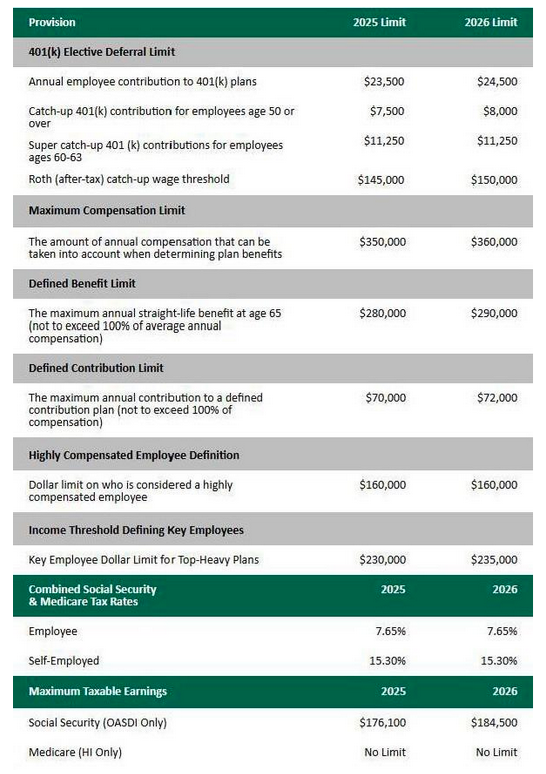
Chart showing 2025 vs 2026

For more information, please contact your Mullin Barens Sanford Consultant via this via this link.

Disclaimer:

The materials are designed to convey accurate and authoritative information concerning the subject matter covered. However, they are provided with the understanding that Mullin Barens Sanford Financial does not engage in the practice of law, or give tax, legal or accounting advise. For advice in these areas, please consult your appropriate advisors.

© 2025 Mullin Barens Sanford Financial and Insurance Services, LLC. All Rights Reserved.
1421 Emerson Avenue, Oxnard, California 93033 | Main (650) 740-7773 | Website: www.mbsfin.com
Securities offered through M Holdings Securities, Inc., a Registered Broker/Dealer, Member FINRA/SIPC. #4444620
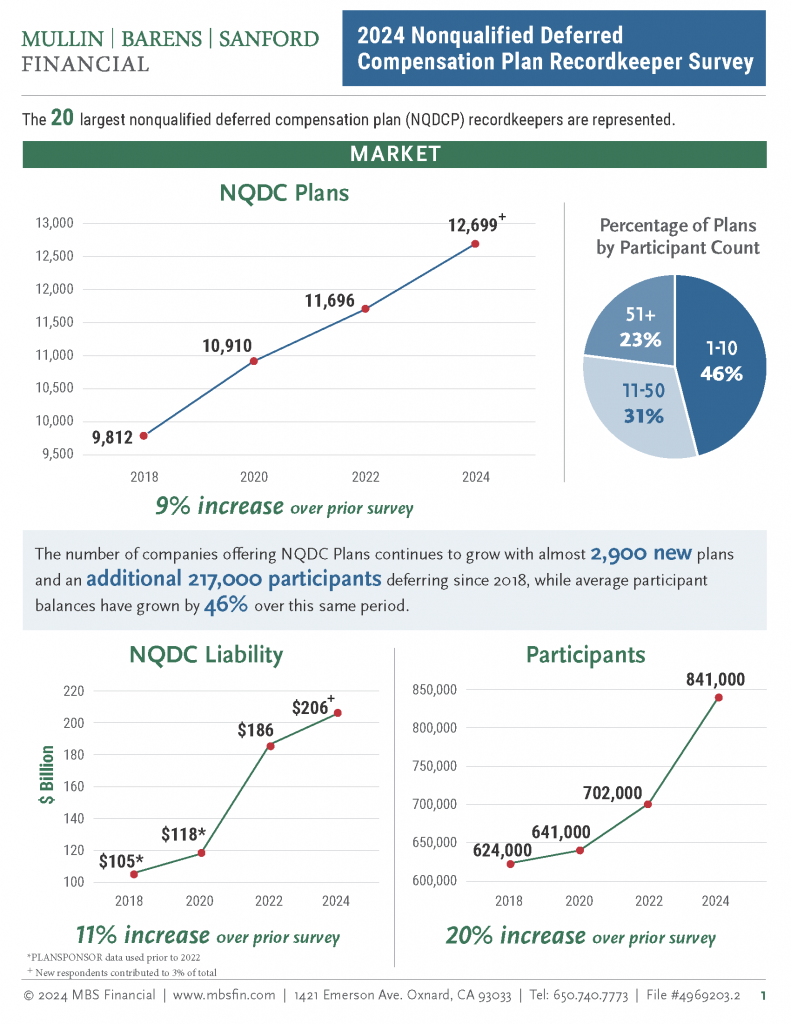
2024 NQDCP Recordkeeper Survey

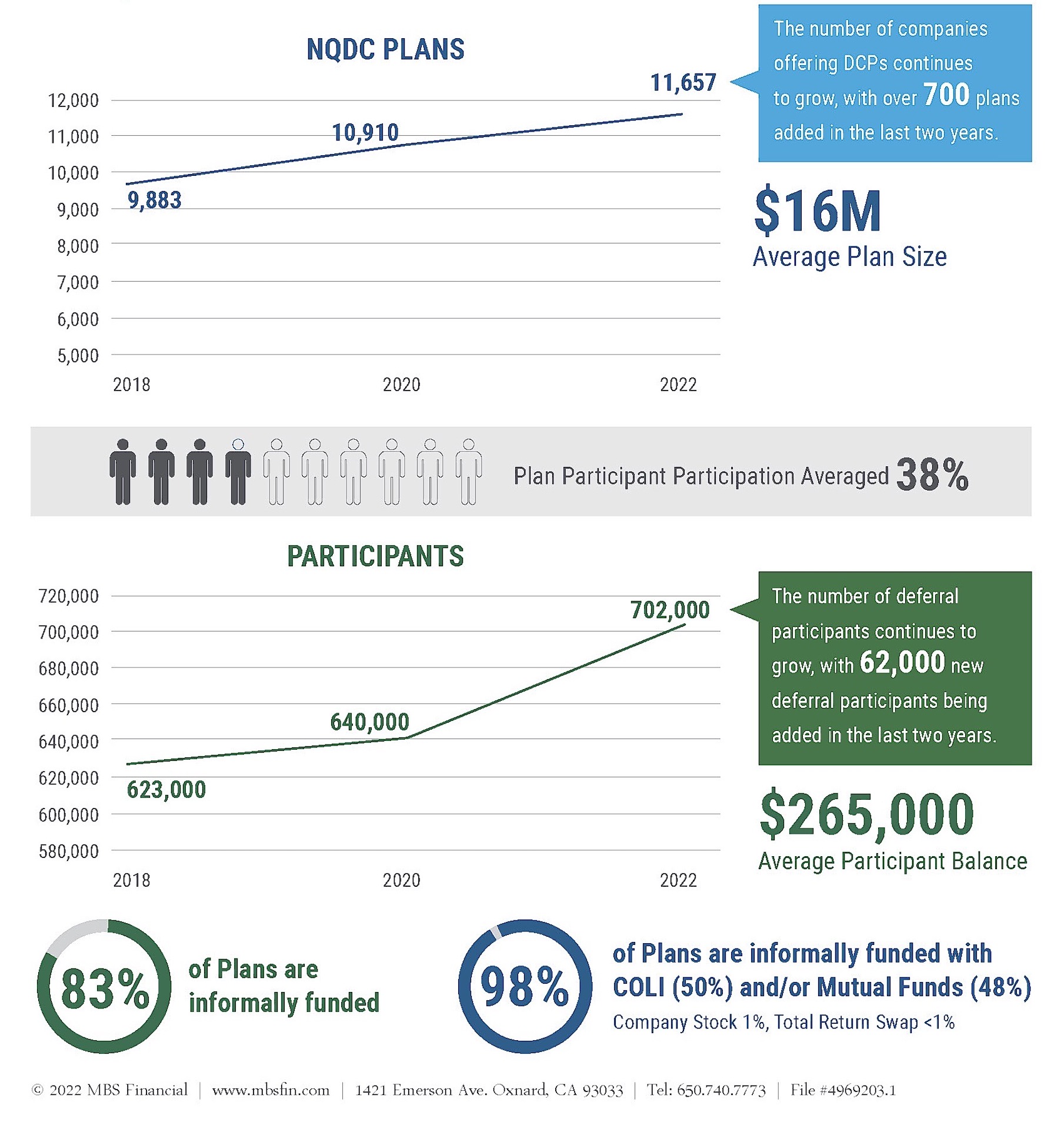
MBS Financial’s 7th survey of the nonqualified deferred compensation plan market is the most comprehensive survey done of the NQDCP marketplace – encompassing over 12,000 plans administered by the 20 largest NQDCP recordkeepers. Data continues to show the value of these plans, with the NQDCP market seeing strong and steady growth as both the number of companies offering NQDCPs and the number of employees choosing to participate increase year over year. You can download the full survey here.

If you have questions or would like additional information on the survey or deferred compensation plans, please contact your MBS Financial consultant via this link.

Who is MBS?

MBS is a highly specialized corporate consulting firm with more than $13 billion dollars of our clients’ corporate investments. We manage over 225 corporate ICOLI and nonqualified plans.  Importantly, we do not replace your current investment advisors. MBS Financial is certified as a women-owned business and is recognized by the Supplier Clearinghouse.

Disclaimer:

The materials are designed to convey accurate and authoritative information concerning the subject matter covered. However, they are provided with the understanding that Mullin Barens Sanford Financial does not engage in the practice of law, or give tax, legal or accounting advice. For advice in these areas, please consult your appropriate advisors.

Variable Universal Life insurance combines the protection and tax advantages of life insurance with the investment potential of a comprehensive selection of variable investment options. The insurance component provides death benefit coverage and the variable component gives you the flexibility to potentially increase the policy’s cash value.

© 2025 Mullin Barens Sanford Financial and Insurance Services, LLC. All Rights Reserved.
1421 Emerson Avenue, Oxnard, California 93033 | Main (650) 740-7773 | Website: www.mbsfin.com
Securities offered through M Holdings Securities, Inc., a Registered Broker/Dealer, Member FINRA/SIPC. #4444620
Mind The (Income Protection) Gap

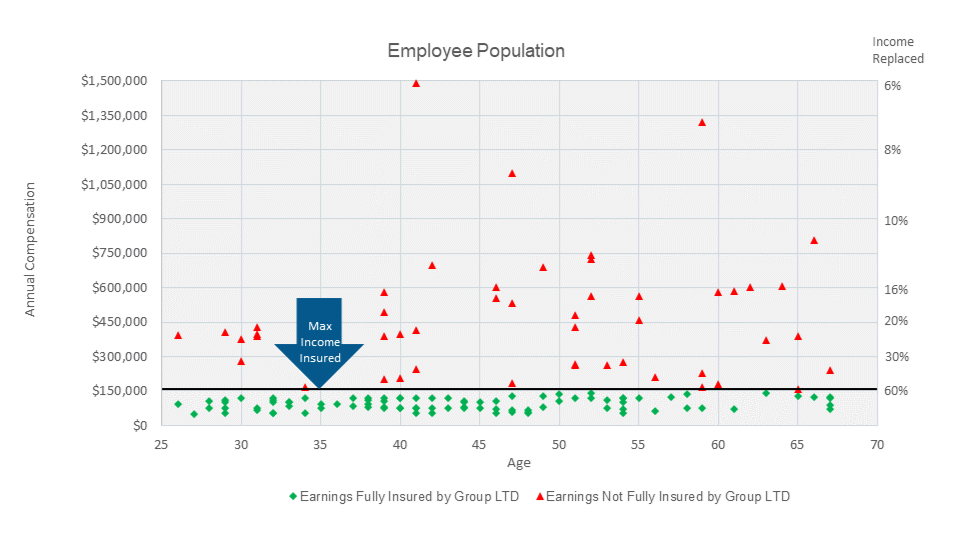
Similar to the way a nonqualified deferred compensation plan provides an opportunity for executives to restore retirement savings rates restricted by IRS limits imposed on 401(k) plans, Supplemental Disability Income Plans can restore the income replacement rates limited for higher earners in Group Long Term Disability (LTD) Plans.

In addition to higher overall base incomes, executives and senior managers often derive a greater proportion of their annual income from variable compensation – a type of compensation generally excluded in Group LTD programs.

The result is employees in this population often do not have the income protection they think they have.

From insufficient income replacement to lost savings and increased expenses, the risks and consequences of a disability are often misunderstood or overlooked.

Consider these hidden risks of disability:

  • 4x greater likelihood of disability than death in the working years
  • High income earners have a greater probability of being the sole wage earner in a household, increasing the financial consequences of a disability
  • You’re likely to fall off your employer’s medical and dental insurance – you would need to pay out of pocket if you wish to maintain you and your family’s medical and dental coverage
  • Retirement savings are suspended
  • Company matching contributions cease

If you would like to evaluate a supplemental disability insurance program for your executive or senior management population, please contact your MBS Financial consultant via this link.

Who is MBS?

MBS is a highly specialized corporate consulting firm with more than $13 billion dollars of our clients’ corporate investments. We manage over 225 corporate ICOLI and nonqualified plans.  Importantly, we do not replace your current investment advisors. MBS Financial is certified as a women-owned business and is recognized by the Supplier Clearinghouse.

Disclaimer:

Variable Universal Life insurance combines the protection and tax advantages of life insurance with the investment potential of a comprehensive selection of variable investment options. The insurance component provides death benefit coverage and the variable component gives you the flexibility to potentially increase the policy’s cash value.

The materials are designed to convey accurate and authoritative information concerning the subject matter covered. However, they are provided with the understanding that Mullin Barens Sanford Financial does not engage in the practice of law, or give tax, legal or accounting advice. For advice in these areas, please consult your appropriate advisors.

© 2025 Mullin Barens Sanford Financial and Insurance Services, LLC. All Rights Reserved.
1421 Emerson Avenue, Oxnard, California 93033 | Main (650) 740-7773 | Website: www.mbsfin.com
Securities offered through M Holdings Securities, Inc., a Registered Broker/Dealer, Member FINRA/SIPC. #4444620
MBS Financial Certified As Women-Owned Business

Mullin Barens Sanford Financial proudly announces certification as a women-owned business. As one of the only women-owned businesses in the nonqualified benefits space, MBS Financial specializes in providing consulting services for the planning, design and implementation of executive benefit plans, as well as tax-efficient funding strategies, including corporate-owned and bank-owned life insurance (COLI and BOLI). Kristi Barens, co-founding principal, plays a pivotal role in the company’s success.

Who is MBS?

MBS is a highly specialized corporate consulting firm with more than $13 billion dollars of our clients’ corporate investments. We manage over 225 corporate ICOLI and nonqualified plans.  Importantly, we do not replace your current investment advisors. MBS Financial is certified as a women-owned business and is recognized by the Supplier Clearinghouse.

Disclaimer:

Variable Universal Life insurance combines the protection and tax advantages of life insurance with the investment potential of a comprehensive selection of variable investment options. The insurance component provides death benefit coverage and the variable component gives you the flexibility to potentially increase the policy’s cash value.

The materials are designed to convey accurate and authoritative information concerning the subject matter covered. However, they are provided with the understanding that Mullin Barens Sanford Financial does not engage in the practice of law, or give tax, legal or accounting advice. For advice in these areas, please consult your appropriate advisors.

© 2025 Mullin Barens Sanford Financial and Insurance Services, LLC. All Rights Reserved.
1421 Emerson Avenue, Oxnard, California 93033 | Main (650) 740-7773 | Website: www.mbsfin.com
Securities offered through M Holdings Securities, Inc., a Registered Broker/Dealer, Member FINRA/SIPC. #4444620
Basic Accounting For ICOLI

ICOLI can provide improvements to your investment returns, but how do you handle this asset on your books?

ICOLI Accounting

ICOLI accounting is straight forward.

GAAP Reporting

    • ICOLI surrender value is reported as an “Other Asset” on your balance sheet. (ASC 325-30)
    • Changes in surrender value are reported as “Other Income” on your income statement. (ASC 325-30)

Statutory Reporting

    • ICOLI is considered an “Admitted Asset”. (SSAP 21(6))
    • ICOLI surrender value is reported on line 25 of the assets side of the balance sheet as “Aggregate write-ins other-than-invested asset”.
    • The specifics of the year-to-year change in the ICOLI values are then added to the detail lines 2501-2598 of the assets side of the balance sheet.
    • Changes in surrender value are reported on line 14 of the income statement as “Details of write-ins aggregated at line 14 for miscellaneous income”.
    • The specifics of the change in the ICOLI values are then added to the detail lines 0501-0598 of the income statement.

If your goal is to increase returns without increasing underlying investment risk, then consider ICOLI.

Would you like to explore how ICOLI can affect your company’s portfolio returns? Please reach out to your Mullin Barens Sanford Associate or schedule a call via this link.

Who is MBS?

MBS is a highly specialized corporate consulting firm with more than $13 billion dollars of our clients’ corporate investments. We manage over 225 corporate ICOLI and nonqualified plans.  Importantly, we do not replace your current investment advisors.

Disclaimer:

Variable Universal Life insurance combines the protection and tax advantages of life insurance with the investment potential of a comprehensive selection of variable investment options. The insurance component provides death benefit coverage and the variable component gives you the flexibility to potentially increase the policy’s cash value.

The materials are designed to convey accurate and authoritative information concerning the subject matter covered. However, they are provided with the understanding that Mullin Barens Sanford Financial does not engage in the practice of law, or give tax, legal or accounting advice. For advice in these areas, please consult your appropriate advisors.

© 2025 Mullin Barens Sanford Financial and Insurance Services, LLC. All Rights Reserved.
1421 Emerson Avenue, Oxnard, California 93033 | Main (650) 740-7773 | Website: www.mbsfin.com
Securities offered through M Holdings Securities, Inc., a Registered Broker/Dealer, Member FINRA/SIPC. #4444620

Moving Out Of State? Don’t Forget About The Source Tax

One well known, yet unexpected result of the COVID-19 pandemic was the mass exodus of individuals out of city centers. For many, that exodus extended to moving out of state, particularly for those seeking to move from high to low income tax states. Open any news site over the last year and there is a good chance you will see an article about people leaving California, New York and New Jersey. For many, particularly those in or close to retirement, the cost of high taxes has outweighed the benefits of living in those states.

What some retirees do not realize, is that the state where they earned their money will assess taxes on their 401(k)s and IRAs, unless they take at least a 10-year distribution[1]. The problem is, many 401(k) and IRAs do not provide investors with a 10 (or more) year distribution option necessary to get the benefit of lower tax rates in the new state.

However, most non-qualified deferred compensation plans have the ability to schedule distribution payments of 10 years or more. A properly designed plan allows participants to save a large portion of their compensation pre-tax and take 10 or more years of annual installments in retirement, exempting them from the source tax. By deferring compensation in high tax states and retiring in a low tax state, those retirees can save a significant amount of tax.

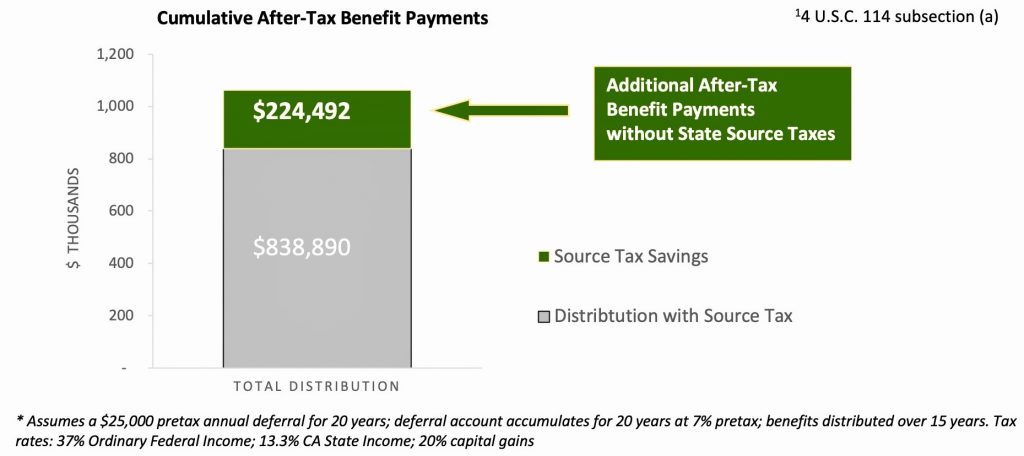
The graph below illustrates a 45-year-old saving $25,000 per year for 20 years, then moving from CA with a 13.3% top tax rate to a 0% income tax state in retirement. Model assumes a 7% pretax growth rate, benefits distributed over 15 years and a 37% ordinary federal income tax rate.

[1]4 U.S.C. 114 subsection (a)

For more information regarding the potential impacts of these proposals, please contact your Mullin Barens Sanford Associate.  Schedule a call via this link to learn more.

About Mullin Barens Sanford Financial

Through a powerful combination of independence and experience, Mullin Barens Sanford Financial and Insurance Services (MBS Financial) is a leading consulting firm that assists companies with 409A and other executive benefit needs.

Disclaimer: The materials are designed to convey accurate and authoritative information concerning the subject matter covered. However, they are provided with the understanding that Mullin Barens Sanford does not engage in the practice of law, or give tax, legal or accounting advice. For advice in these areas please consult your appropriate advisors.

© 2025 Mullin Barens Sanford Financial and Insurance Services, LLC. All Rights Reserved.
1421 Emerson Avenue, Oxnard, California 93033 | Main (650) 740-7773 | Website: www.mbsfin.com
Securities offered through M Holdings Securities, Inc., a Registered Broker/Dealer, Member FINRA/SIPC. #4444620

2022 MBS NQDCP Recordkeeper Survey

Our 6th survey of nonqualified deferred compensation plan information demonstrates the continued growth of the industry. Data was compiled from 11 of the largest deferral recordkeepers (including two recent consolidations) with $186 billion in liabilities, 11,657 plans and 702,000 participants.

Disclaimer: The materials are designed to convey accurate and authoritative information concerning the subject matter covered. However, they are provided with the understanding that Mullin Barens Sanford does not engage in the practice of law, or give tax, legal or accounting advice. For advice in these areas please consult your appropriate advisors.

© 2023 Mullin Barens Sanford Financial and Insurance Services, LLC. All Rights Reserved.
1421 Emerson Avenue, Oxnard, California 93033 |Main 650.740.7773 |Website: www.mbsfin.com
Securities offered through M Holdings Securities, Inc., a Registered Broker/Dealer, Member FINRA/SIPC. #4969203.1

How REITs Can Hedge An Employee Benefit

Informally funding a DCP without Triggering Distribution Requirements

In order for Real Estate Investment Trusts (“REITS”) to maintain their designated tax treatment status, they must meet the annual REIT testing requirements. REITS are required to distribute at least 90% of taxable income in the form of dividend payments to their shareholders. Income realized through the growth of mutual funds – even to pay an employee benefit – must be included in the taxable income calculation, causing significant shortfalls when plan balances rise.

Deferred Compensation Plan Funding

Deferred compensation plans (“DCPs”) are common throughout the REIT landscape as they are a tool used to attract and retain top industry talent. Although non-qualified deferred compensation plans cannot be formally funded, many REITS elect to set assets aside in a rabbi trust to informally fund the promised future benefits to its employees. When selecting the funding vehicle to hedge the deferred compensation plan balances, REITS typically choose between mutual funds or corporate owned life insurance. However, an important consideration that is commonly overlooked, is that any realized gains from a sale or rebalancing of mutual funds used for funding the DCP will trigger income included in the dividend distribution requirements.

For example, if a plan participant elects to defer $10,000 of their income into their DCP account and that value increases by 50% before the distribution date, then the REIT will owe that plan participant $15,000. However, if the REIT is using mutual funds to hedge the participants DCP account, then at least 90% of that 50% gain must be included in the dividend distribution payment, leaving the REIT only $10,500 left over to hedge the $15,000 distribution payment. REITS are essentially in a 90% “tax rate” for any realized gains on mutual funds.

Corporate Owned Life Insurance

  • Gains inside of a COLI policy may not be subject to REIT dividend distribution requirements
  • COLI provides a significantly better hedge for funding DCP liabilities when compared to taxable securities
  • Death benefit proceeds generated by COLI policies are also excluded from dividend distribution requirements

If you would like to discuss the deferred compensation plan funding options for REITS, please call your Mullin Barens Sanford Consultant.

Disclaimer: The materials are designed to convey accurate and authoritative information concerning the subject matter covered. However, they are provided with the understanding that Mullin Barens Sanford does not engage in the practice of law, or give tax, legal or accounting advice. For advice in these areas please consult your appropriate advisors.

© 2025 Mullin Barens Sanford Financial and Insurance Services, LLC. All Rights Reserved.
1421 Emerson Avenue, Oxnard, California 93033 | Website: www.mbsfin.com
Securities offered through M Holdings Securities, Inc., a Registered Broker/Dealer, Member FINRA/SIPC. #4444620

The Fundamentals Of Insurance Company Owned Life Insurance (“ICOLI”)

According to statutory filings, US insurance companies own more than $30B dollars of institutional life insurance. This Article describes the basic attributes of ICOLI, the applicable tax and regulatory structure, the available investments, the process to acquire ICOLI and how insurance companies deploy this strategy to increase investment yields.

Insurance companies purchase institutionally priced life insurance to:

  • offset or recover employee benefit costs,
  • hedge against potential economic loss stemming from the death of an executive,
  • provide death benefit coverage based to their management-employees perquisites and
  • improve overall investment yield.

ICOLI contracts provide both death benefits when an insured passes away and yield to a cash value account during the life of the insured. The cash value account yields depend on the investment options offered in the contract and selected by the policyowner. This cash value account accumulates and is accounted for as an asset while the insured is living. When an insured passes away, the cash value is paid to the policyowner as part of the contract’s tax-free death proceeds.

How can ICOLI maximize yield

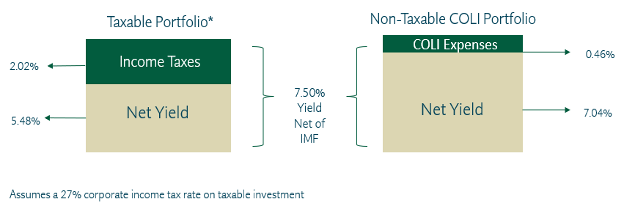
ICOLI maximizes investment yield through tax deferred growth of cash value, tax free death benefits and lower risk-based capital charges than investments held outside of ICOLI. A lower risk-based capital charge allows less total capital to be deployed for a given investment, therefore creating a more efficient deployment of capital.

What investments are available within ICOLI

Investments available within ICOLI contracts are extremely diverse and span multiple asset classes. Commonly included in the offering are fixed income options, various categories and durations of bond funds, growth blend and value equity funds, along with international options, specialty funds and alternative fund strategies.

Companies issuing ICOLI conduct due diligence on the funds and the fund managers they offer within their ICOLI products. Due diligence is conducted both when a fund is proposed to be added to the platform and periodically thereafter to ensure the fund meets the Company standards. Funds that do not meet an issuing company’s qualitative and quantitative standards are not offered or are removed from the platform.

The vast array of investments available within ICOLI make it easy for a purchasing insurance company to match its investment strategy. As investment strategy changes over time, the ICOLI investment allocation can be easily changed in a tax efficient manner. Unlike traditional investments, reallocations within ICOLI are not taxable.

Tax Characteristics

Cash value

Tax-deferred growth is permitted by Internal Revenue Code (“Code”) sections 7702(g) and 72(e), which provide that inside build-up or “gain” is not taxable if the contract continues to meet the definition of life insurance under Code section 7702(g) and no taxable distributions are made from the policy under Code section 72(e). The same code sections apply to tax-free reallocations within ICOLI.

Cost of insurance charges are typically less than income taxes, resulting in an increased yield over a taxable portfolio.

Death Benefit

ICOLI contracts provide tax-free death proceeds when the contract’s insured passes away.  For a company to receive this tax free death benefits, code section 101(j) requires the policyowner at the time of purchase to obtain consent from its insureds, and the insureds must be among the top 35% most highly compensated employees of the purchasing insurance company. The company issuing ICOLI provides the purchaser a 101(j) compliant consent form.

Risk-based capital reserving

In addition to tax benefits, ICOLI receives lower potential risk-based capital reserving requirements than investments held outside of ICOLI. The National Association of Insurance Commissioners (“NAIC”) risk-based capital reserving system dictates the amount of capital an insurance company must set aside for various investment risks. Categories of risks covered by risk-based capital reserving are asset risk, insurance risk, interest rate risk and business risk.

The amount of capital required for a given investment depends on the risk factors of the investment. An insurance company purchasing equities may have to set aside a hedge of 30% of the value of the purchased equity to meet this risk-based capital reserve requirement. Yet, if the insurance company purchased ICOLI and allocated to similar equities within the ICOLI contract, the risk-based capital charge would be dramatically less – 0% or 5%.

The risk-based capital charge for all investments made within ICOLI is set at a static rate of 5% for property and casualty insurance companies and 0% for life and health insurance companies. Therefore, an investment in equities within an ICOLI contract will require less capital than an investment in a similar category outside of an ICOLI contract.

In addition to NAIC reserving requirements, ratings agencies have adopted a risk-based capital reserving formula to help grade an insurance company’s financial strength which includes ICOLI investments. For example, AM Best assigns an 0.08 charge to reserves for ICOLI, thus not looking through ICOLI to the underlying investments.

Accounting

Both the Generally Accepted Accounting Principles (GAAP) and the Statements of Statutory Accounting Principles (SSAP) provide clear guidance for ICOLI.

GAAP

Accounting guidance for ICOLI is found in the Accounting Codification Standard 325-30. The cash surrender value of a life policy is entered on the contract owner’s balance sheet as an “Other Asset” and the change in the cash surrender value is entered on the owner’s income statement as “Other Income.”

Sample journal entries

Premium Payment

Investment in ICOLI

Cash

Debit

$25,000,000

Credit

$25,000,000

Change in surrender value

Investment in ICOLI

Gain on Investment in ICOLI

$1,750,000 

$1,750,000

SSAP

SSAP 21(6) provides that the cash surrender value of a life policy is entered on the owner’s statutory balance sheet as “Aggregate Write-ins Other than Invested Assets” on Line 25, with an explanation of the asset in “Details of Write-ins” identified as “Cash Surrender Value of Life Insurance.” SSAP 21(6) also requires change in cash surrender value be reflected on the owner’s statement of income as “Details of Write-ins Aggregated” on line 14 for “Miscellaneous Income.”

Sample journal entries

Premium Payment

Aggregate Write-ins for Other Than Invested Assets

Cash

Debit

$25,000,000

Credit

$25,000,000

Change in surrender value

Aggregate Write-ins for Other Income

Gain on Investment in ICOLI


$1,750,000


$1,750,000

Tax Reporting

Internal Revenue Code section 6039I and the associated Treasury Regulation section 1.6039I-1 require the owner to attach Form 8925 to its tax return for each year they own the policy. Form 8925 must include the number of individuals employed by the insurance company, the number of employees it insures, the total amount of death benefit covering the insured employees and whether valid consent was obtained from an insured employee. The insurance company must keep a record sufficient to show that proper notice and consent was obtained from the insured employee.

Underwriting

The life insurance company issuing ICOL conducts a simplified assessment of the purchasing insurance company to ensure it is financially capable of purchasing the ICOLI. This financial assessment is conducted using the publicly available statutory filing of the purchasing insurance company and typically requires no additional financial information from the purchaser.

In addition, the life insurance company issuing ICOLI requires a census of proposed insured employees and will determine if the group meets its guaranteed issue (GI) underwriting guidelines. GI allows the issuing ICOLI company to issue policies without requiring any medical underwriting. The proposed insureds must simply answer a few basic questions when providing consent. The questions typically asked are whether the proposed insured is actively at work full-time, whether they have missed work for a recent period due to illness, and whether they are a tobacco user.

Role of the consultant

Pre-purchase and implementation

During an insurance company’s exploration of ICOLI, the consultant provides:

  • information on the tax, accounting, financial, regulatory, risk and rating impacts of a purchase,
  • financial modeling of various life insurance product structures,
  • life insurance company study of available products,
  • financial comparison of various ICOLI products,
  • draft materials for presentation to the board of directors,
  • negotiate life insurance policy contract pricing terms, and
  • management of the acquisition and implementation process.

Post-purchase ongoing administration

A consultant provides the following ongoing services:

  • servicing the ICOLI for the life of the policies or help the client select a third-party recordkeeper to conduct ongoing administration.
    • Administration includes: quarterly investment reviews, assisting in the preparation of annual IRS compliance and state regulatory reporting materials, providing periodic accounting reviews, supplying applicable carrier investment menu updates, conducting annual issuing carrier reviews to ensure ongoing dedication to the marketplace, and more.
  • The consultant must also be capable of keeping an up to date understanding of the ongoing tax, legal, investment, accounting, regulatory, and rating environment and how it affects the ICOLI policyowner.

Conclusion

ICOLI is an effective tool for hedging benefit liabilities and improving investment yield.  The path through education, design, carrier selection, implementation, and into ongoing administration can be significantly streamlined if the purchaser engages an experienced consultant.

This information is for general and educational purposes and not intended as legal, tax, accounting, securities, or investment advice, nor an opinion regarding the appropriateness of any investment, nor a solicitation of any type. Information obtained from third-party sources are believed to be reliable but not guaranteed. #3851795.2

Disclaimer: The materials are designed to convey accurate and authoritative information concerning the subject matter covered. However, they are provided with the understanding that Mullin Barens Sanford does not engage in the practice of law, or give tax, legal or accounting advice. For advice in these areas please consult your appropriate advisors.

© 2025 Mullin Barens Sanford Financial and Insurance Services, LLC. All Rights Reserved.
1421 Emerson Avenue, Oxnard, California 93033 | Main (650) 740-7773 | Website: www.mbsfin.com
Securities offered through M Holdings Securities, Inc., a Registered Broker/Dealer, Member FINRA/SIPC. #4444620

How To Battle The Great Resignation With Deferred Compensation Plans

EMILY R. LANGDON, JD

FRASER STRYKER PC LLO

This article is co-authored by Emily Langdon, Partner, Fraser Stryker, PC LLO.

Email Address: elangdon@fraserstryker.com | Office Phone: (402) 978-5386

Emily focuses her practice on employee benefits and ERISA. As part of this practice, Emily assists her clients with matters related to health and welfare benefits, executive compensation, pension and retirement plans, wellness plans, and life insurance law. Emily also has significant experience in the areas of health care law, corporate transactions, business formation and advising, and employment law, all of which compliment her benefits work.

ERIK SPEED, ASSOCIATE PRINCIPAL

MULLIN BARENS SANFORD FINANCIAL

The article is co-authored by Erik Speed, Associate Principal, Mullin Barens Sanford Financial.

Email Address: erik.speed@mbsfin.com | Office Phone: (818) 292-7206

Erik has been a trusted partner to advisors and clients for many years. He has built his career on the pillars of integrity, dedication, and unbiased consultation. He has significant experience working with corporate clients on their executive benefit programs and corporate insurance solutions.

Executive Summary

This article explores how a company can use a deferred compensation plan (“DCP”) as a tool to overcome the executive recruitment and retention challenges produced by “The Great Resignation”. For more information, the reader is encouraged to connect with the authors directly.

What is the Great Resignation?

During April 2021, amid the COVID-19 pandemic, the number of employees who quit their jobs in just one month broke a previously unsurpassed record in the United States. Economists call this “The Great Resignation.”  April was only the beginning of this so-called “Great Resignation”. In July, even more employees quit. Yet again, the number of “quits” — the term coined by the Bureau of Labor Statistics — reached new record highs in August and again in November, and there is no expectation of a reversal in the near term. In fact, “[n]early a quarter of workers plan a job change or retirement in the next 12–18 months, and 81% of plan sponsors are concerned about increased competition for talent.”[1]

With a tightening labor market, employers are feeling the squeeze at all aptitude levels, especially in their battle to retain executive leadership and attract new executives. The question employers are left with is how to combat a workforce terminating voluntarily – with a tight labor-market, with supply-chain issues, and with a pandemic? An immediate tool: provide a DCP specifically designed to overcome recruitment and retention challenges. What is a DCP?

What is a Deferred Compensation Plan (DCP)?

In this context, a DCP is an agreement between or among an employer and one or more employees that permits an employee to delay receipt of compensation to a later year (e.g., short-term [2-10 years] or long-term [retirement]). The plan also permits the employer to make discretionary contributions to an employee’s account and dictate vesting requirements for these contributions (e.g., recruitment bonus with three-year cliff vesting). There are no statutory limitations on the amount a participant can defer, or an employer can contribute.[2] Participants are typically given the ability to direct which investments their deferrals or vested employer contributions track. The investment menu is created by the employer. Typically, a recordkeeper tracks and credits participant investment returns to their respective accounts daily.

Like qualified plans, DCPs are primarily used because of the tax-preference received through the Internal Revenue Code (“Code”). Under a properly structured plan, employer contributions and employee deferrals are made tax-deferred.[3] Tax is also deferred on investment yield and investment reallocation[4] — resulting in a tax-preferred investment environment. Income tax is typically recognized when distributions are received by the participant.[5]

Permissible distributions from DCPs generally occur at separation from service, a specified date (including in-service), as a result of a change in control, the death or disability of a participant, or in the event of an unforeseeable emergency.[6] These distributions can be made as a lump sum or can be scheduled to occur as installments spanning several years.[7] There are no required minimum distributions or penalty for receiving distributions before age 59½.[8]

Rules governing DCPs require discrimination in favor of a select group of management or highly compensated employees.[9] As long as the plan is “a plan which is unfunded and is maintained by an employer primarily for the purpose of providing deferred compensation for a select group of management or highly compensated employees”, the plan is exempt from ERISA’s minimum participation and vesting rules, its funding rules, and its fiduciary responsibility rules (including the trust requirement).[10]

DCPs are a mechanism employers use to strategically meet compensation and benefits issues faced by their more highly compensated employee pool. These plans can and should be designed to meet the challenges created by changing economic and social issues. For example, “The Great Resignation” has created issues for employers seeking to recruit or retain top-level talent — and a properly designed DCP can meet these challenges regardless of how fluid the challenges are.

Can DCPs be designed to meet challenges posed by the “Great Resignation”?

  • The plan should permit custom recruiting bonuses to be contributed to an employee’s DCP account. Custom, time-based vesting schedules could also be permitted to be tied to such bonuses. Using this feature, an employer can make tax-deferred recruiting bonuses as needed to attract select talent. A new employee sees the immediate – albeit, unvested – account balance allowing the employer to show the new employee immediate value with no current cash outlay from the employer. The custom vesting schedule provides the employer the latitude to determine its retention needs relating to each newly recruited key employee.
  • The plan should permit custom retention contributions to be made to an employee’s DCP account. Again, custom, time-based vesting schedules should be permitted and tied to these contributions. Using this feature, an employer can make discretionary retention contributions as needed to retain select talent. Like recruiting or sign-on bonuses, an employee would see the tax-deferred value of this employer contribution in their DCP account without any required current cash outlay from the employer.
  • The plan should permit an employee to defer their current compensation (salary, bonus, etc.). Permitting deferrals of compensation allows the employee to offset “separation from service distributions” the employee may have received as a result of leaving the previous employer to join the new company. A “separation from service distribution” comes from the previous employer’s DCP and are taxed as ordinary income to the employee. Permitting deferral of new compensation allows the newly recruited employee to neutralize the “separation from service distribution” income tax increase by deferring a like amount into the new employer’s plan. Without a DCP, the new employee’s ability to manage income and tax will be limited to whatever nominal qualified plan deferrals are available to the employee – this can be significantly less deferral capacity than what is needed. To be effective, a new highly compensated employee should be immediately eligible to defer his or her compensation.
  • The plan should permit special contributions to be made to an employee’s account. Special contributions can be used to offset unvested benefits the employee lost as a result of leaving the previous employer to join the new employer. Lost benefits can range from lost DCP account balances or non-account balance benefits, equity compensation, qualified plan benefits, and so on. Permitting special contributions provides the recruiting employer a flexible mechanism with which it can restore the benefits an employee may lose as a result of joining the new company, thereby allowing the recruiting employer to overcome recruiting hurdle rates created by unvested benefits. The new employee sees the restored benefit immediately and individualized vesting can be tied to company objectives. Having a plan with this one-off flexibility can be key for the recruitment of highly talented employees.

How can DCPs create value beyond meeting the challenges of the “Great Resignation”?

Pre-tax retirement savings capacity is a critical component of the American retirement system. Without pre-tax deferral capacity a key employee’s ability to accumulate assets for retirement is significantly damaged. The most common pre-tax savings plan in America is the 401(k) plan. A 401(k) plan exists to provide most employees with tax incentives to save for their own retirement. Unfortunately, the amount of compensation deferrable under a 401(k) plan is extremely limited by Code section 402(g) – $20,500 in 2022. The deferral limit is often further reduced for highly compensated employees when the ADP and ACP nondiscrimination tests are applied.

Layering a basic DCP into a highly compensated employee’s benefits may fully restore the deferral capacity the employee may have lost by virtue of being a key employee. Generally, a DCP is the only plan that provides high earners the ability to invest compensation in an unlimited amount on a tax-deferred basis. For that reason, DCPs are commonly used as a foundation of executive retirement programs, and when used as such, are an extremely powerful accumulation tool.

There is limited ability for highly compensated employees to provide themselves a meaningful tax-deferred retirement investment platform outside of an employer sponsored DCP. Non-highly compensated employees can defer a large percentage of their compensation under a 401(k) plan and have additional options outside of an employer sponsored plan – such as using an IRA to make pre-tax or tax-deferred contributions. Not providing a basic DCP to highly compensated employees put those employees and the employer at an unnecessary disadvantage.

Final thoughts

While it is clear that the American workforce is in a state of tremendous transition, it is also very clear that a primary factor driving those changes is that individuals do want to work for employers who can meet their needs. A company deploying strategic benefits packages is more capable of meeting the needs of individual executive employees.

The process of designing or assessing a DCP begins with the assistance of an experienced DCP consultant. By combining the skill of a DCP professional with the knowledge of an ERISA attorney, a plan sponsor can collaborate with an experienced team to successfully establish or amend a DCP to meet its corporate goals and needs — both short-term and long-term. The reader is encouraged to reach out to the Authors if interested in implementing a DCP or to request the review of a current plan.

This material and the opinions voiced are for general information only and are not intended to provide specific advice or recommendations. To determine what is appropriate, please contact a financial professional.

This information is for general and educational purposes and not intended as legal, tax, accounting, securities, or investment advice, nor an opinion regarding the appropriateness of any investment, nor a solicitation of any type. Information obtained from third-party sources are believed to be reliable but not guaranteed.

File # 4355261.1

[1] Survey results show workers looking at changes, less confident in economy. Principal Financial Group. November 9, 2021.

[2] IRC Section 409A.

[3] Id.

[4] 26 CFR § 31.3121(v)(2)-1.

[5] Id.

[6] 26 USC Section 409A(a)(2)(A).

[7] See, e.g., 26 CFR Section 1.409A-3(b).

[8] 26 USC Section 72(t)(2)(A)(i).

[9] Sections 201, 301(a)(3), and 401(a)(1) of ERISA.

[10] Id.

Disclaimer: The materials are designed to convey accurate and authoritative information concerning the subject matter covered. However, they are provided with the understanding that Mullin Barens Sanford does not engage in the practice of law, or give tax, legal or accounting advice. For advice in these areas please consult your appropriate advisors.

© 2025 Mullin Barens Sanford Financial and Insurance Services, LLC. All Rights Reserved.
1421 Emerson Ave, Oxnard CA 93033 | Main (650) 740-7773| Website: www.mbsfin.com
Securities offered through M Holdings Securities, Inc., a Registered Broker/Dealer, Member FINRA/SIPC. #4444620

Next Page »

Recent Posts

  • IRS Announcement: 2026 Qualified Retirement Plan Limits
  • 2024 NQDCP Recordkeeper Survey
  • Mind The (Income Protection) Gap
  • MBS Financial Certified As Women-Owned Business
  • Basic Accounting For ICOLI

Recent Comments

No comments to show.
Mullin Barens Sanford Financial & Insurance Services

Disclosures | Privacy Policy (PDF, opens in a new tab)
© 2026 Mullin Barens Sanford Financial & Insurance Services, LLC

  • Our Services
    • NQDCP
    • COLI
    • BOLI
    • ICOLI
    • Executive Disability
  • About MBS Financial
    • About Us
    • Our Team
    • The Mullin Legacy
    • M Financial Group
  • Resources
    • Surveys
    • Insights
    • News
    • Contact Us
M Financial Group Member Firm

We value your privacy

We use cookies to keep this site reliable, understand how it’s used, and — with your permission — to personalize content. You can accept all, reject non-essential, or choose which categories to allow.

Cookie Preferences