
Mullin Barens Sanford Financial & Insurance Services
    • NQDCP
    • COLI
    • BOLI
    • ICOLI
    • Executive Disability
    • About Us
    • Our Team
    • The Mullin Legacy
    • M Financial Group
    • Surveys
    • Insights
    • News
  • Contact Us
    • NQDCP
    • COLI
    • BOLI
    • ICOLI
    • Executive Disability
    • About Us
    • Our Team
    • The Mullin Legacy
    • M Financial Group
    • Surveys
    • Insights
    • News
  • Contact Us

How To Battle The Great Resignation With Deferred Compensation Plans

EMILY R. LANGDON, JD

FRASER STRYKER PC LLO

This article is co-authored by Emily Langdon, Partner, Fraser Stryker, PC LLO.

Email Address: elangdon@fraserstryker.com | Office Phone: (402) 978-5386

Emily focuses her practice on employee benefits and ERISA. As part of this practice, Emily assists her clients with matters related to health and welfare benefits, executive compensation, pension and retirement plans, wellness plans, and life insurance law. Emily also has significant experience in the areas of health care law, corporate transactions, business formation and advising, and employment law, all of which compliment her benefits work.

ERIK SPEED, ASSOCIATE PRINCIPAL

MULLIN BARENS SANFORD FINANCIAL

The article is co-authored by Erik Speed, Associate Principal, Mullin Barens Sanford Financial.

Email Address: erik.speed@mbsfin.com | Office Phone: (818) 292-7206

Erik has been a trusted partner to advisors and clients for many years. He has built his career on the pillars of integrity, dedication, and unbiased consultation. He has significant experience working with corporate clients on their executive benefit programs and corporate insurance solutions.

Executive Summary

This article explores how a company can use a deferred compensation plan (“DCP”) as a tool to overcome the executive recruitment and retention challenges produced by “The Great Resignation”. For more information, the reader is encouraged to connect with the authors directly.

What is the Great Resignation?

During April 2021, amid the COVID-19 pandemic, the number of employees who quit their jobs in just one month broke a previously unsurpassed record in the United States. Economists call this “The Great Resignation.”  April was only the beginning of this so-called “Great Resignation”. In July, even more employees quit. Yet again, the number of “quits” — the term coined by the Bureau of Labor Statistics — reached new record highs in August and again in November, and there is no expectation of a reversal in the near term. In fact, “[n]early a quarter of workers plan a job change or retirement in the next 12–18 months, and 81% of plan sponsors are concerned about increased competition for talent.”[1]

With a tightening labor market, employers are feeling the squeeze at all aptitude levels, especially in their battle to retain executive leadership and attract new executives. The question employers are left with is how to combat a workforce terminating voluntarily – with a tight labor-market, with supply-chain issues, and with a pandemic? An immediate tool: provide a DCP specifically designed to overcome recruitment and retention challenges. What is a DCP?

What is a Deferred Compensation Plan (DCP)?

In this context, a DCP is an agreement between or among an employer and one or more employees that permits an employee to delay receipt of compensation to a later year (e.g., short-term [2-10 years] or long-term [retirement]). The plan also permits the employer to make discretionary contributions to an employee’s account and dictate vesting requirements for these contributions (e.g., recruitment bonus with three-year cliff vesting). There are no statutory limitations on the amount a participant can defer, or an employer can contribute.[2] Participants are typically given the ability to direct which investments their deferrals or vested employer contributions track. The investment menu is created by the employer. Typically, a recordkeeper tracks and credits participant investment returns to their respective accounts daily.

Like qualified plans, DCPs are primarily used because of the tax-preference received through the Internal Revenue Code (“Code”). Under a properly structured plan, employer contributions and employee deferrals are made tax-deferred.[3] Tax is also deferred on investment yield and investment reallocation[4] — resulting in a tax-preferred investment environment. Income tax is typically recognized when distributions are received by the participant.[5]

Permissible distributions from DCPs generally occur at separation from service, a specified date (including in-service), as a result of a change in control, the death or disability of a participant, or in the event of an unforeseeable emergency.[6] These distributions can be made as a lump sum or can be scheduled to occur as installments spanning several years.[7] There are no required minimum distributions or penalty for receiving distributions before age 59½.[8]

Rules governing DCPs require discrimination in favor of a select group of management or highly compensated employees.[9] As long as the plan is “a plan which is unfunded and is maintained by an employer primarily for the purpose of providing deferred compensation for a select group of management or highly compensated employees”, the plan is exempt from ERISA’s minimum participation and vesting rules, its funding rules, and its fiduciary responsibility rules (including the trust requirement).[10]

DCPs are a mechanism employers use to strategically meet compensation and benefits issues faced by their more highly compensated employee pool. These plans can and should be designed to meet the challenges created by changing economic and social issues. For example, “The Great Resignation” has created issues for employers seeking to recruit or retain top-level talent — and a properly designed DCP can meet these challenges regardless of how fluid the challenges are.

Can DCPs be designed to meet challenges posed by the “Great Resignation”?

  • The plan should permit custom recruiting bonuses to be contributed to an employee’s DCP account. Custom, time-based vesting schedules could also be permitted to be tied to such bonuses. Using this feature, an employer can make tax-deferred recruiting bonuses as needed to attract select talent. A new employee sees the immediate – albeit, unvested – account balance allowing the employer to show the new employee immediate value with no current cash outlay from the employer. The custom vesting schedule provides the employer the latitude to determine its retention needs relating to each newly recruited key employee.
  • The plan should permit custom retention contributions to be made to an employee’s DCP account. Again, custom, time-based vesting schedules should be permitted and tied to these contributions. Using this feature, an employer can make discretionary retention contributions as needed to retain select talent. Like recruiting or sign-on bonuses, an employee would see the tax-deferred value of this employer contribution in their DCP account without any required current cash outlay from the employer.
  • The plan should permit an employee to defer their current compensation (salary, bonus, etc.). Permitting deferrals of compensation allows the employee to offset “separation from service distributions” the employee may have received as a result of leaving the previous employer to join the new company. A “separation from service distribution” comes from the previous employer’s DCP and are taxed as ordinary income to the employee. Permitting deferral of new compensation allows the newly recruited employee to neutralize the “separation from service distribution” income tax increase by deferring a like amount into the new employer’s plan. Without a DCP, the new employee’s ability to manage income and tax will be limited to whatever nominal qualified plan deferrals are available to the employee – this can be significantly less deferral capacity than what is needed. To be effective, a new highly compensated employee should be immediately eligible to defer his or her compensation.
  • The plan should permit special contributions to be made to an employee’s account. Special contributions can be used to offset unvested benefits the employee lost as a result of leaving the previous employer to join the new employer. Lost benefits can range from lost DCP account balances or non-account balance benefits, equity compensation, qualified plan benefits, and so on. Permitting special contributions provides the recruiting employer a flexible mechanism with which it can restore the benefits an employee may lose as a result of joining the new company, thereby allowing the recruiting employer to overcome recruiting hurdle rates created by unvested benefits. The new employee sees the restored benefit immediately and individualized vesting can be tied to company objectives. Having a plan with this one-off flexibility can be key for the recruitment of highly talented employees.

How can DCPs create value beyond meeting the challenges of the “Great Resignation”?

Pre-tax retirement savings capacity is a critical component of the American retirement system. Without pre-tax deferral capacity a key employee’s ability to accumulate assets for retirement is significantly damaged. The most common pre-tax savings plan in America is the 401(k) plan. A 401(k) plan exists to provide most employees with tax incentives to save for their own retirement. Unfortunately, the amount of compensation deferrable under a 401(k) plan is extremely limited by Code section 402(g) – $20,500 in 2022. The deferral limit is often further reduced for highly compensated employees when the ADP and ACP nondiscrimination tests are applied.

Layering a basic DCP into a highly compensated employee’s benefits may fully restore the deferral capacity the employee may have lost by virtue of being a key employee. Generally, a DCP is the only plan that provides high earners the ability to invest compensation in an unlimited amount on a tax-deferred basis. For that reason, DCPs are commonly used as a foundation of executive retirement programs, and when used as such, are an extremely powerful accumulation tool.

There is limited ability for highly compensated employees to provide themselves a meaningful tax-deferred retirement investment platform outside of an employer sponsored DCP. Non-highly compensated employees can defer a large percentage of their compensation under a 401(k) plan and have additional options outside of an employer sponsored plan – such as using an IRA to make pre-tax or tax-deferred contributions. Not providing a basic DCP to highly compensated employees put those employees and the employer at an unnecessary disadvantage.

Final thoughts

While it is clear that the American workforce is in a state of tremendous transition, it is also very clear that a primary factor driving those changes is that individuals do want to work for employers who can meet their needs. A company deploying strategic benefits packages is more capable of meeting the needs of individual executive employees.

The process of designing or assessing a DCP begins with the assistance of an experienced DCP consultant. By combining the skill of a DCP professional with the knowledge of an ERISA attorney, a plan sponsor can collaborate with an experienced team to successfully establish or amend a DCP to meet its corporate goals and needs — both short-term and long-term. The reader is encouraged to reach out to the Authors if interested in implementing a DCP or to request the review of a current plan.

This material and the opinions voiced are for general information only and are not intended to provide specific advice or recommendations. To determine what is appropriate, please contact a financial professional.

This information is for general and educational purposes and not intended as legal, tax, accounting, securities, or investment advice, nor an opinion regarding the appropriateness of any investment, nor a solicitation of any type. Information obtained from third-party sources are believed to be reliable but not guaranteed.

File # 4355261.1

[1] Survey results show workers looking at changes, less confident in economy. Principal Financial Group. November 9, 2021.

[2] IRC Section 409A.

[3] Id.

[4] 26 CFR § 31.3121(v)(2)-1.

[5] Id.

[6] 26 USC Section 409A(a)(2)(A).

[7] See, e.g., 26 CFR Section 1.409A-3(b).

[8] 26 USC Section 72(t)(2)(A)(i).

[9] Sections 201, 301(a)(3), and 401(a)(1) of ERISA.

[10] Id.

Disclaimer: The materials are designed to convey accurate and authoritative information concerning the subject matter covered. However, they are provided with the understanding that Mullin Barens Sanford does not engage in the practice of law, or give tax, legal or accounting advice. For advice in these areas please consult your appropriate advisors.

© 2025 Mullin Barens Sanford Financial and Insurance Services, LLC. All Rights Reserved.
1421 Emerson Ave, Oxnard CA 93033 | Main (650) 740-7773| Website: www.mbsfin.com
Securities offered through M Holdings Securities, Inc., a Registered Broker/Dealer, Member FINRA/SIPC. #4444620
Are Deferred Compensation Plans (DCPs) An Executive Perk?

No, DCPs restore lost savings opportunities and fit in an egalitarian culture.

Many companies say yes. Here are the reasons why:

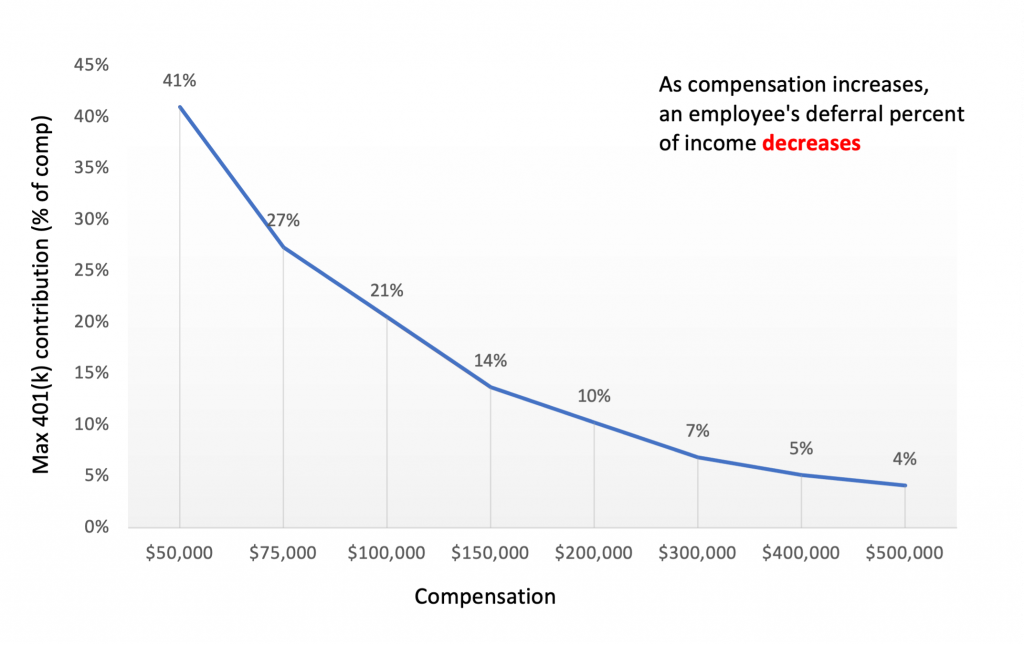
Issue: Highly compensated employees (HCEs) are in fact discriminated against by 401(k) contribution limits and testing. In 2022, an HCE is defined by the IRS as having total compensation of $135k or more (IRC Section 415).

Unfair 401(k): An employee under age 50 earning $200k in 2022 can only defer a maximum of 10.25% ($20,500) in the 401(k). The same employee earning $100k could defer 20.5% of their income ($20,500). This difference compounds yearly and negatively affects the replacement income ratio of the HCE approaching retirement.

Why 401(k)s Are Not Enough for HCEs

How can the plan sponsor make up for the reduced deferral opportunity that can affect HCEs in the 401(k)?

Potential Solution: The employees affected by 401(k) limits can be offered a nonqualified Deferral Restoration Plan (DCP). To keep the plan egalitarian, it is possible to design the plan to only allow the affected employees the ability to defer the same percentage of the same income that the 401(k) allows.

Proxy Disclosure: Companies that strive to be egalitarian may also be concerned about the optics of offering a Deferral Restoration Plan. Here are some examples of proxy disclosures for companies that have a 401(k) Deferral Restoration Plan:

  • No pension or other special benefits
  • No significant perquisites
  • We do not provide excessive perquisites, benefits or severance benefits
  • No excessive perks
  • No excessive pension or SERPs

Conclusion: Deferral plans are flexible and can be customized to meet the specific needs of the plan sponsor. They are an important element of tax planning for key employees and can be a valuable tool for managing several types of taxable income including restricted stock units (RSUs). These tax management benefits can assist companies in efforts to recruit and retain the best employees. Over 90% of large companies (over $1B revenue) already offer at least one deferral plan(1). If your company strives to maintain egalitarian benefits, then it should consider restoring its HCEs’ ability to defer income for retirement at the same rate as its non-HCEs.

For more information about how to design a deferral plan that helps the company provide equal deferral opportunities to its HCEs, please contact your Mullin Barens Sanford Consultant via this link.

(1) Compensation, Retirement and Benefits Trends Report, Newport Group, 2018/2019

Disclaimer: The materials are designed to convey accurate and authoritative information concerning the subject matter covered. However, they are provided with the understanding that Mullin Barens Sanford does not engage in the practice of law, or give tax, legal or accounting advice. For advice in these areas please consult your appropriate advisors.

© 2025 Mullin Barens Sanford Financial and Insurance Services, LLC. All Rights Reserved.
1421 Emerson Avenue, Oxnard, California 93033 | Website: www.mbsfin.com
Securities offered through M Holdings Securities, Inc., a Registered Broker/Dealer, Member FINRA/SIPC. #4444620
Record Group Insurance Death Claims In 2021

Rate Increases Likely to Follow

Last year, group life insurance companies experienced a record number of death claims. Two recent reports include:

  • MetLife’s adjusted quarterly earnings in the U.S. group-benefits unit plummeted 95% to $20 million, from $383 million the year-earlier with increased deaths of younger people (i.e., those under age 65) with employer-sponsored benefits.  MetLife paid out $1.06 for each $1 of group-life-insurance premium collected.
  • OneAmerica, one of the largest providers of group life insurance in the U.S., announced a 40% increase in the annual death rate as 2021 produced the most deaths in the history of the life insurance industry.

Shockingly, the surge in death claims cannot be directly attributed to the COVID-19 virus. Though nearly 1,000,000 people died of COVID in the United States in 2021, the majority of the increased death rate is attributable to tertiary factors brought on by the pandemic response. A combination of fewer routine checkups as well as understaffed hospitals led to many more preventable deaths.

Continued high death claims have insurance companies adjusting– what will follow are cost increases and more restrictions on coverage. Benefits and finance teams will need to be creative to provide competitive coverage for a reasonable cost, particularly at a time when employees find life insurance a necessary benefit.

A Solution

Particularly at executive levels, group insurance can be expensive for the company and executives. Rather than paying for group coverage on executives, companies purchase individual life insurance coverage with enhanced benefits and potentially lower executive tax costs.

  • Individual life insurance has not experienced the dramatic rate increases seen in group insurance.
  • Individual life insurance is an asset of the company; cash value remains on the company’s balance sheet offsetting the premium expense.
  • Individual life insurance may provide favorable imputed income rates, lowering the executive’s income tax cost.

If you would like to discuss how individual life insurance can be utilized in place of group insurance, please call your Mullin Barens Sanford Consultant. Schedule a call via this link to learn more.

About Mullin Barens Sanford Financial

Through a powerful combination of independence and experience, Mullin Barens Sanford Financial and Insurance Services (MBS Financial) is a leading consulting firm that assists companies with 409A and other executive benefit needs.

Disclaimer: The materials are designed to convey accurate and authoritative information concerning the subject matter covered. However, they are provided with the understanding that Mullin Barens Sanford does not engage in the practice of law, or give tax, legal or accounting advice. For advice in these areas please consult your appropriate advisors.

© 2025 Mullin Barens Sanford Financial and Insurance Services, LLC. All Rights Reserved.
1421 Emerson Ave, Oxnard 93033 | Website: www.mbsfin.com
Securities offered through M Holdings Securities, Inc., a Registered Broker/Dealer, Member FINRA/SIPC. #4444620

Nonqualified Deferred Compensation Plan (DCP Aka 409A) Participant User’s Guide

MBS Principal John Sanford and Consultant Nicko Burnett have co-authored an article to address the lack of public information on how a participant can effectively and efficiently utilize a DCP to help improve their financial outlook: a true user’s guide. That article, Nonqualified Deferred Compensation Plans (DCP aka 409A): A Participant User’s Guide, is published in the Fall 2021 edition of The Journal of Deferred Compensation: Nonqualified Plans and Executive Compensation, a peer reviewed journal focusing on nonqualified plans and Section 409A of the tax code (article available here).

DCPs have long been seen as an exceptional and necessary benefit to offer key employees of companies large and small.  According to the latest PSCA Survey, over 90% of companies surveyed (private and public) have at least one DCP.  Internet searches turn up articles about how DCPs work and why company should offer one; missing from that library is any help for a participant in a plan.

With that in mind, the Participant User’s Guide answers the most common questions asked by participants:

  • Should I participate?
  • Does short term deferral work?
  • When should my distributions occur?
  • How should I invest my balance?
  • Should I use the DCP to save for my children’s college education, a second home, or retirement?
  • What if my goals change?
  • What happens if my company gets sold or goes bankrupt?

If your plan doesn’t allow for some of the flexible plan features compliant with 409A regulations that can be beneficial to participants and plan sponsors, please contact your Mullin Barens Sanford Financial Consultant via this link.

About Mullin Barens Sanford Financial

Through a powerful combination of independence and experience, Mullin Barens Sanford Financial and Insurance Services (MBS Financial) is a leading consulting firm that assists companies with 409A and other executive benefit needs.

Disclaimer: The materials are designed to convey accurate and authoritative information concerning the subject matter covered. However, they are provided with the understanding that Mullin Barens Sanford does not engage in the practice of law, or give tax, legal or accounting advice. For advice in these areas please consult your appropriate advisors.

© 2025 Mullin Barens Sanford Financial and Insurance Services, LLC. All Rights Reserved.
1421 Emerson Avenue, Oxnard, California 93033 | Website: www.mbsfin.com
Securities offered through M Holdings Securities, Inc., a Registered Broker/Dealer, Member FINRA/SIPC. #4444620

2015 – How To Pick A TPA For A Non-Qualified Plan 7 Tips

Disclaimer: The materials are designed to convey accurate and authoritative information concerning the subject matter covered. However, they are provided with the understanding that Mullin Barens Sanford does not engage in the practice of law, or give tax, legal or accounting advice. For advice in these areas please consult your appropriate advisors.

© 2025 Mullin Barens Sanford Financial and Insurance Services, LLC. All Rights Reserved.
2242 Purdue Avenue, Los Angeles, California 90064 | Website: www.mbsfin.com
Securities offered through M Holdings Securities, Inc., a Registered Broker/Dealer, Member FINRA/SIPC. #4444620

BOLI Market Update – 2Q 2021 Further Contraction Of Treasury Yields

Further Contraction of Treasury Yields Combined with Bank’s Low Interest Projections over time Led to Exponential Growth in BOLI

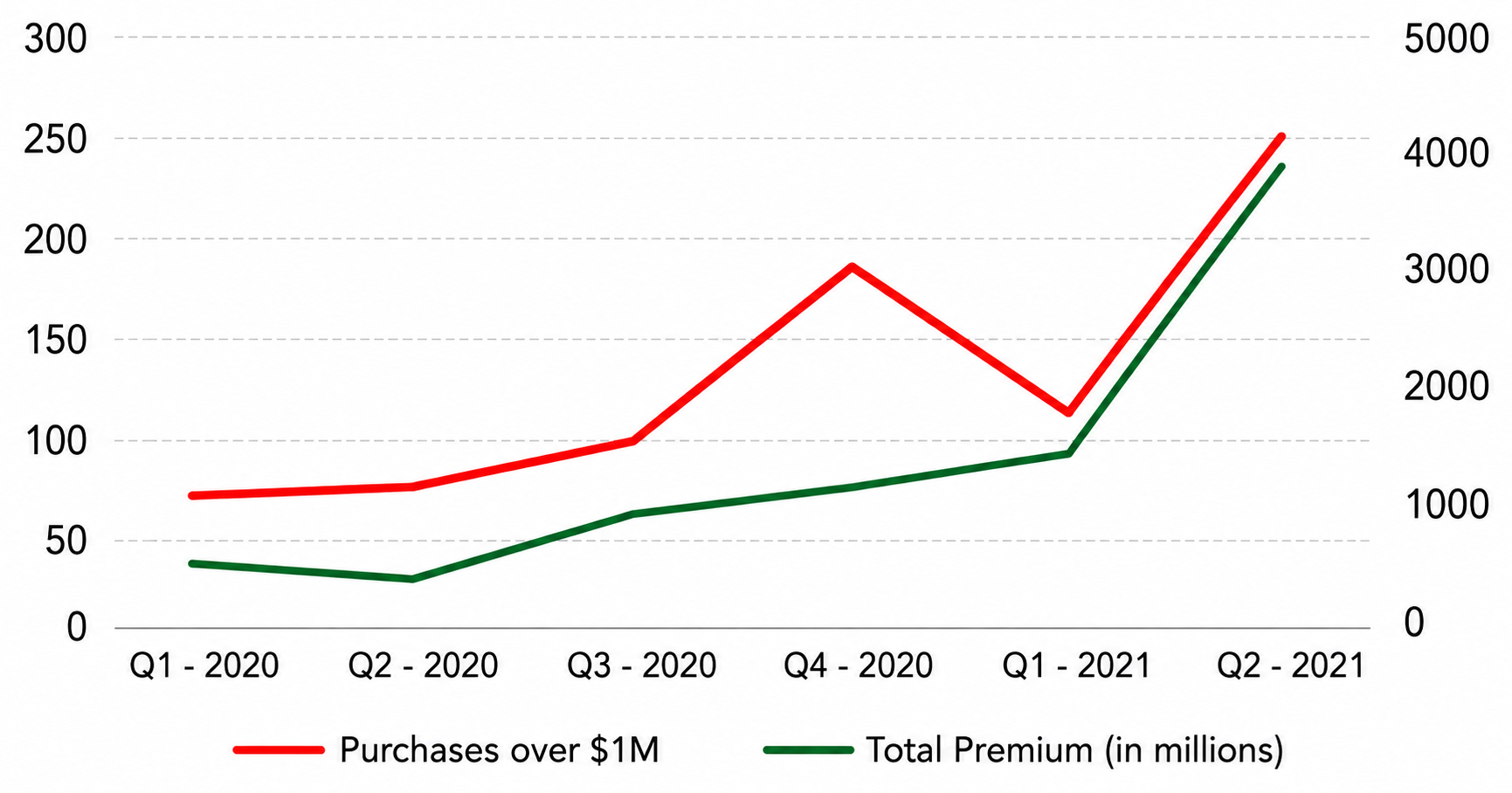
BOLI’s unprecedented run of prominence reached a new height in the second quarter of 2021.  Both the number of purchases and amount of written premium jumped more than double quarter over quarter and grew by 3 and 8 orders of magnitude Year over Year, respectively.

Line chart: BOLI purchases over $1M and total premium in millions, Q1 2020 through Q2 2021, both rising sharply in Q2 2021

Two main factors have driven BOLI’s performance and growth: the continued low interest rate environment and projections that any rate recovery will be long and drawn out.  After brief signs of Treasury relief in the first quarter of 2021, yields dipped again during the second quarter.  Then, even as the Federal reserve has indicated that interest rates will be on the rise some time in the near future, Banks are projecting increases to be small and slow moving.

In seeking return while limiting interest rate risk, Banks have been turning to BOLI to meet both criteria.  BOLI crediting rates are highly competitive with other bank permissible assets, while providing an asset which will respond to prevailing interest rates over time.

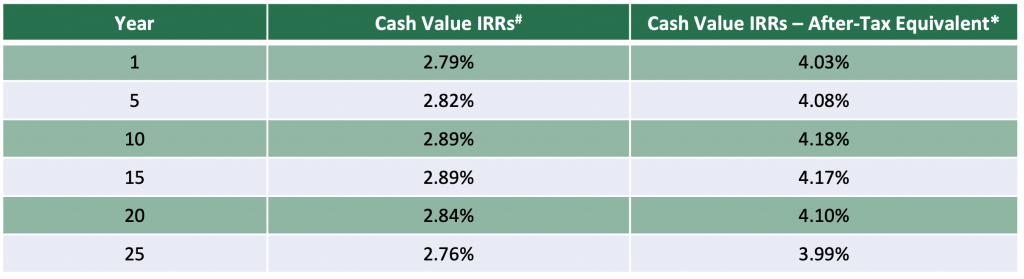
Assumptions: $10 million guaranteed issue BOLI purchase, 29% corporate tax rate

Source: 2Q2021 FDIC Bank Call Reports

If you have any questions about BOLI or would like to explore how BOLI could fit into your portfolio, please contact your Mullin Barens Sanford Consultant.

About Mullin Barens Sanford Financial

Through a powerful combination of independence and experience, Mullin Barens Sanford Financial and Insurance Services (MBS Financial) is a leading consulting firm that assists companies with 409A and other executive benefit needs.

Disclaimer: The materials are designed to convey accurate and authoritative information concerning the subject matter covered. However, they are provided with the understanding that Mullin Barens Sanford does not engage in the practice of law, or give tax, legal or accounting advice. For advice in these areas please consult your appropriate advisors.

© 2025 Mullin Barens Sanford Financial and Insurance Services, LLC. All Rights Reserved.
1421 Emerson Ave, Oxnard, California 93033 | Website: www.mbsfin.com
Securities offered through M Holdings Securities, Inc., a Registered Broker/Dealer, Member FINRA/SIPC. #4444620

Prudential Announces Sale Of Retirement Business To Empower – US Subsidiary Of Great West Life

On July 21st, Prudential Financial announced the sale of its retirement segment to Empower, a large player in the qualified retirement plan marketplace, for $3.55 Billion.  The deal is expected to close during the first quarter of 2022, pending regulatory approvals.

The acquisition will allow Empower to further solidify its place in the United States retirement market by adding approximately 4,300 separate workplace retirement plans, 4 million plan participants, and $314 Billion in assets.  This addition includes a robust, non-qualified plan business and recordkeeping platform – an arena in which Empower had been only sparingly involved to this point, particularly in the large employer space.  Adding Prudential’s non-qualified plan business will nearly triple the number of plans on which Empower works (from about 350 to 900) and expand their reach to individual participants from 34,000 to 106,000.

Empower’s acquisition and resulting entry into the non-qualified plan space is the next in a string of consolidations of providers offering both types of plans, following Voya’s acquisition of PenCal and Prudential’s earlier acquisition of MullinTBG.

Mullin Barens Sanford Financial remains committed to providing independent consulting for non-qualified plans and will continue to monitor this acquisition and any impact it may have on our clients.

For more information, please contact your Mullin Barens Sanford Associate.  Schedule a call via this link to learn more.

About Mullin Barens Sanford Financial

Through a powerful combination of independence and experience, Mullin Barens Sanford Financial and Insurance Services (MBS Financial) is a leading consulting firm that assists companies with 409A and other executive benefit needs.

Disclaimer: The materials are designed to convey accurate and authoritative information concerning the subject matter covered. However, they are provided with the understanding that Mullin Barens Sanford does not engage in the practice of law, or give tax, legal or accounting advice. For advice in these areas please consult your appropriate advisors.

© 2025 Mullin Barens Sanford Financial and Insurance Services, LLC. All Rights Reserved.
1421 Emerson Ave., Oxnard, California 93033 | Website: www.mbsfin.com
Securities offered through M Holdings Securities, Inc., a Registered Broker/Dealer, Member FINRA/SIPC. #4444620

Disability Insurance Reminder

Disability insurance tends to be one of the most overlooked benefit programs in corporate America today. However, an employee experiencing a disability event is a real threat to employers, as 25% of employees entering the workforce today will experience a disability event lasting 90 days or longer during their working years. Group Long Term Disability (LTD) plans provide an essential foundation of coverage for your company’s employees. Unfortunately, LTD plans may often fall short in addressing the income replacement needs of highly compensated employees.

Group LTD May Not Cover Everything You Think It Does

The graphic below illustrates that employees making over $120,000 a year will receive less than the 60% income replacement plan design should they become disabled with only the sample group plan as there is a $10,000/monthly maximum benefit.

Consider Corporate Sponsored Individual Disability Insurance to Bridge the Gap

Corporate sponsorship of coverage provides key benefits:

  • Guaranteed Issue coverage – no medical underwriting
  • Salary and performance-based compensation covered
  • Lower Cost Coverage than employees buying policies on their own in the retail market
    • Multi-Life guaranteed issue rates are 10-30% lower than traditional individual rates
    • 66% of individuals applying for disability insurance either get declined or rated
  • Portable coverage allows executives to take their policy with them in case of employment change

For more information on how Individual Disability Insurance solves the income replacement needs of your employees, please contact your Mullin Barens Sanford Associate.  Schedule a call via this link to learn more.

About Mullin Barens Sanford Financial

Through a powerful combination of independence and experience, Mullin Barens Sanford Financial and Insurance Services (MBS Financial) is a leading consulting firm that assists companies with 409A and other executive benefit needs.

Disclaimer: The materials are designed to convey accurate and authoritative information concerning the subject matter covered. However, they are provided with the understanding that Mullin Barens Sanford does not engage in the practice of law, or give tax, legal or accounting advice. For advice in these areas please consult your appropriate advisors.

© 2025 Mullin Barens Sanford Financial and Insurance Services, LLC. All Rights Reserved.
1421 Emerson Ave., Oxnard, California 93033 | Website: www.mbsfin.com
Securities offered through M Holdings Securities, Inc., a Registered Broker/Dealer, Member FINRA/SIPC. #4444620

Biden Releases Budget And Green Book

FINSECA Takes a Deep Dive into the Green Book

On Friday, May 28th the Biden Administration released the 6 trillion-dollar budget for the upcoming fiscal year. Accompanying the release of the 2022 budget package was the “Green Book”, which details the tax proposals contained within the budget.

For an in-depth analysis of the proposals contained within the green book and the potential impact these proposals will have on corporations and individuals alike, please click the link below.

FINSECA Budget and Green Book Summary

For more information on how this budget release may affect plan sponsors and individuals, please contact your Mullin Barens Sanford Associate.  Schedule a call via this link to learn more.

About Mullin Barens Sanford Financial

Through a powerful combination of independence and experience, Mullin Barens Sanford Financial and Insurance Services (MBS Financial) is a leading consulting firm that assists companies with 409A and other executive benefit needs.

Disclaimer: The materials are designed to convey accurate and authoritative information concerning the subject matter covered. However, they are provided with the understanding that Mullin Barens Sanford does not engage in the practice of law, or give tax, legal or accounting advice. For advice in these areas please consult your appropriate advisors.

© 2025 Mullin Barens Sanford Financial and Insurance Services, LLC. All Rights Reserved.
1421 Emerson Ave., Oxnard, California 93033 | Website: www.mbsfin.com
Securities offered through M Holdings Securities, Inc., a Registered Broker/Dealer, Member FINRA/SIPC. #4444620

Why Hundreds Of Insurance Carriers Hold ICOLI

Hundreds of insurance carriers hold insurance company owned life insurance (ICOLI) as part of their investment strategy. Why?

The answer is simple. ICOLI has the equity return potential of stock, with the tax characteristics of tax-free bonds (tax-deferred gain is converted to tax-free yield if held to maturity), and efficient risk-based capital charges, 0% to 5%.

Because of this, allocating a portion of investable monies to ICOLI is now commonplace amongst insurance companies.

Each ICOLI strategy is unique to the yield goals, investment strategy, and risk appetite of each purchasing carrier. ICOLI investment strategies range from S&P 500 strategies to private equity.

There are several hundred investment strategies available within ICOLI. Investments within ICOLI undergo the providing carrier’s investment due diligence process. The result is that fund managers are scrutinized and must be selected to appear on their ICOLI platforms.

Unlike general account ICOLI, separate account ICOLI is not subject to the claims of the bankruptcy creditors of the issuing carrier.

Why carriers purchase ICOLI through MBS?  We know the marketplace. We make objective ICOLI carrier recommendations and guide our clients based on the principles of competitive ICOLI pricing and long-term pricing fidelity, ICOLI carrier strength and ratings, ICOLI carrier experience in and dedication to the ICOLI marketplace, ICOLI investments offered and their respective investment selection process, and more.

We are here to help you navigate your potential ICOLI investment.

Would you like to explore how ICOLI can affect your company’s portfolio returns? Please reach out.

Who is MBS?

MBS is a highly specialized corporate consulting firm with more than $13 billion dollars of our clients’ corporate investments. We manage over 225 corporate ICOLI and nonqualified plans.  Importantly, we do not replace your current investment advisors.

Erik Speed
Associate Principal
(818) 292-7206
Erik.Speed@mbsfin.com

Disclaimer:

Variable Universal Life insurance combines the protection and tax advantages of life insurance with the investment potential of a comprehensive selection of variable investment options. The insurance component provides death benefit coverage and the variable component gives you the flexibility to potentially increase the policy’s cash value.

The materials are designed to convey accurate and authoritative information concerning the subject matter covered. However, they are provided with the understanding that Mullin Barens Sanford Financial does not engage in the practice of law, or give tax, legal or accounting advice. For advice in these areas, please consult your appropriate advisors.

© 2025 Mullin Barens Sanford Financial and Insurance Services, LLC. All Rights Reserved.
1421 Emerson Ave., Oxnard, California 93033 | Main (650) 740-7773 | Website: www.mbsfin.com
Securities offered through M Holdings Securities, Inc., a Registered Broker/Dealer, Member FINRA/SIPC. #4444620

« Previous Page
Next Page »

Recent Posts

  • 2026 MBS NQDC Recordkeeper Survey
  • IRS Announcement: 2026 Qualified Retirement Plan Limits
  • 2024 NQDCP Recordkeeper Survey
  • Mind The (Income Protection) Gap
  • MBS Financial Certified As Women-Owned Business

Recent Comments

No comments to show.
Mullin Barens Sanford Financial & Insurance Services

Disclosures | Privacy Policy (PDF, opens in a new tab)
© 2026 Mullin Barens Sanford Financial & Insurance Services, LLC

  • Our Services
    • NQDCP
    • COLI
    • BOLI
    • ICOLI
    • Executive Disability
  • About MBS Financial
    • About Us
    • Our Team
    • The Mullin Legacy
    • M Financial Group
  • Resources
    • Surveys
    • Insights
    • News
    • Contact Us
M Financial Group Member Firm

We value your privacy

We use cookies to keep this site reliable, understand how it’s used, and — with your permission — to personalize content. You can accept all, reject non-essential, or choose which categories to allow.

Cookie Preferences